Saturday, August 10, 2013

Letter From Miami

 Letter From Miami

By Michael Deibert

The Huffington Post


Posted: 08/09/2013 11:44 am
 
(This article originally appeared here) 

At about the time Miami Beach Police Department officers were fatally tasing 18-year-old artist and skateboarder Israel Hernandez-Llach, I was rising for the day in my apartment a few blocks away. Morning is generally the most sedate and appealing of time in the tropics, and as one side of my building faces east towards the sea, watching the sunlight cut blazing and orange through the gossamer clouds at dawn while drinking a coffee is one of the great pleasures of living here. In the midst of writing a particularly dark book about Mexican drug cartels, the moment also serves as a kind of respite, as well.

As I was sipping my coffee, Hernandez-Llach, a lithe fellow who had moved to Miami with his family from Colombia a few years ago, was confronted by police as he began tagging his graffiti name -- Reefa -- on a building at the corner of Collins Avenue and 71st Street. He only had time to write the "R" before police started chasing him. The building -- an abandoned shell that used to be a McDonald's whose windows are now covered in newspaper -- was hardly an architectural gem, and a number of other residents and I had actually commented how the look of the place had been improved by the graffiti that had started appearing there.

The police -- by most accounts almost half a dozen -- chased Hernandez-Llach throughout the neighborhood before cornering him, tasering him and reportedly high-fiving one another as he lay on the ground. Hernández was taken to the hospital where was pronounced dead. The official cause of death is still pending.

The news that authorities in Miami place a higher value on real estate -- however derelict -- than human life will come as little surprise to anyone who has been living here for the last several years, nor will the fact that the various police forces operating in Miami-Dade County (as the wider conglomeration of which Miami Beach is a part of is known) are largely out of control.

Just last month, a U.S. Department Of Justice report on the City of Miami Police Department, just across the glittering waters of Biscayne Bay from Miami Beach, found that the department "has engaged in a pattern or practice of excessive use of force through officer-involved shootings in violation of the Fourth Amendment of the Constitution" and that the Department was also tainted by "deficient tactics, improper actions by specialized units, as well as egregious delays and substantive deficiencies in deadly force investigations."

Back here on the beach, one often gets the impression that many police feel they they're on Spring Break, rather than policing those who are, such as when a uniformed cop took a woman on a drunken pre-dawn joy ride on his department-issued ATV and ran over -- and then left -- two tourists waiting to see the sunrise. In another incident, the city had to pay out a $75,000 settlement after two officers were accused of beating a handcuffed gay man, attacking a witness and spewing anti-gay epithets. One officer was fired, then reinstated. The circumstances of the 2011 fatal shooting of Raymond Herisse during the largely African-American Urban Beach Weekend have yet to be fully explained. Meanwhile, in tony Bal Harbour, the police force there treated itself to $3,200 golf outings, trips to Puerto Rico and shopping sprees at the exclusive Bal Harbour Shoppes mall with millions of dollars the department had seized from drug dealers.

The death of Hernandez caps a summer during which a kind of malaise has settled over the city that even a second consecutive Miami Heat NBA championship can't quite dissipate.

Miami-Dade County is governed by a convoluted system whereby the mayor and the Board of County Commissioners run the county as a whole, but within the county there are innumerable little quasi-independent "cities" (some only stretching a few blocks) that have their own police forces, zoning ordinances and so on. One county commissioner, Javier D. Souto, said at a recent special session of the commission that I attended that the system was so complex that even some of the commissioners themselves didn't fully understand it.

Carlos A. Giménez, a retired Cuban-American firefighter, was elected Miami-Dade County mayor in June 2011 following the recall of Mayor Carlos Alvarez (largely bankrolled by former Philadelphia Eagles owner Norman Braman). Promising reform and clean governance, Giménez has thus far seemed to have forgotten that governing a city is about more than lining the pockets of its already fabulously wealthy real estate developers.

Miami's skyline is dotted with construction cranes servicing a luxury apartment boom (a 2011 UBS study ranked Miami as the richest city in the country by pure domestic purchasing power), but the city also has the second-highest income inequality rate in the United States.

Miami-Dade County borrowed about $400 million to pay for a new stadium for the Miami Marlins baseball team by selling bonds on Wall Street, and one set of stadium bonds - worth about $90 million - will now cost the county more than $1 billion to pay back.

After proposing a small property tax rate hike to enable to county to maintain basic services such as fire rescue, libraries and no-kill animal shelters, Giménez reversed course and supported the country commission's 8-4 vote to cut services, later declaring "the age of the library is probably ending" when people questioned the wisdom of the county closing nearly half its branches. This no doubt came as music to the ears of Commissioner Juan C. Zapata, who voted to defund the libraries and whose "non-profit" Read2Succeed! "actively promotes the importance of literacy and unites our community through the power of reading." Or, in other words, does what libraries do but less efficiently and on a far smaller scale.

One must also wonder, given the role of libraries as internet centers, where Miami-Dade's 10 percent unemployed will now apply for unemployment online, as Florida Governor Rick Scott recently required they do (such measures are taken when Scott is not busy trying to purge voters from state rolls) or where they will find free internet to find a new job online.

It seems as if not a single week passes without some elected official being lead away in handcuffs. This week it was Sweetwater Mayor Manuel Maroño and Miami Lakes Mayor Michael Pizzi hauled in by FBI agents for conspiring to commit extortion. A few weeks before that it was Former Hialeah Mayor Julio Robaina (who finished second in the 2011 Miami-Dade County mayoral race behind Gimenez) for tax evasion. Who it will be next week is anybody's guess.

The charms of the city remain considerable. The lavender twilights, the musical lilt of Spanish, Portuguese and Haitian Creole one hears on the streets, the festiveness with which the city explodes into a street party at the drop of a hat. And what other municipality in the United States would declare 3:05 p.m. an official coffee break time, when all should pause and reflect on the magnificence of the cafecito?

Nevertheless, in the needless death of Israel Hernandez-Llach, who was just starting his life, one can briefly glimpse a city whose values seem increasingly awry, putting the almighty dollar reflected in that famous skyline above the citizens who live beneath it and, now, above human life itself.

This evening, just as the rain clouds were getting ready to roll onto the beach from the ocean, I went and looked at the makeshift memorial that had sprung up outside the derelict building that Israel Hernandez-Llach had been spray painting when Miami Beach police set upon him. "I'll see you around" read one note. "Rest in Paradise" read another. And "I'll miss you so much, brother." As I stood there, a young man with a ponytail and a goatee, probably also about 18, pulled up on his bike and gently placed two spray paint cans above the doorway where someone had place a bouquet of flowers.

"I didn't know him personally," the youth said to me. "But you've got to give mad respect to him. As a street artist."

And then he got on his bike and peddled away just as it began to rain.

Friday, August 09, 2013

Monday, July 29, 2013

Wednesday, July 17, 2013

Why Arrest of Zetas Leader Does Not Mean End to Mexico's Drug War

Posted: 07/16/2013 8:34 pm
Why Arrest of Zetas Leader Does Not Mean End to Mexico's Drug War
By Michael Deibert
The Huffington Post
(Read the original article here) 

In the violence that has claimed more than 60,000 lives in Mexico since 2006, the criminal organization know as Los Zetas have been the perpetrators of some sickening crimes.

Originally made up of largely of deserters from a special forces unit of the Mexican army and since buffeted by rogue elements of the Guatemalan military and common thugs, Los Zetas (named after a Mexican radio code for high-ranking officers) were originally recruited in the 1990s by the Gulf Cartel, based in Matamoros, Mexico, just across the Rio Grande from Brownsville, Texas.

With its roots stretching all the way back to Prohibition, the Gulf Cartel at the time was battling the Sinaloa Cartel from Mexico's Pacific Coast for control of its slice of the country's border with the United States. The battle ended with a Gulf Cartel victory, but shortly thereafter the alliance splintered when Gulf gunmen killed a deputy of one of the leaders of Los Zetas, a smuggler born in Mexico but raised largely in Texas named Miguel Ángel Treviño Morales, aka Z-40.

What followed was a war between the Gulf Cartel and Los Zetas for control of the states of
Tamaulipas and Nuevo León that, in its savagery, surpassed nearly anything the country had seen before.

In these states Mexico's Partido Revolucionario Institucional (PRI) -- which ruled the country for 71 years until 2000 and to which Mexico's current president, Enrique Peña Nieto, belongs -- was often viewed as little more than a Gulf Cartel vassal, and a series of governors were later indicted for links to organized crime. Los Zetas, for their part, expanded their influence to the nearby states of Coahuila, Hidalgo and Veracruz. The two cartels appeared to try and outdo one another, with gruesome public displays and videotaped executions becoming commonplace. Ironically, the Gulf Cartel was forced to form an alliance of convenience with its former enemies in the Sinaloa Cartel to fend off their one-time employees.

Los Zetas' actions often seemed demonic in their ferocity. The organization committed a series of massacres in the San Fernando Valley region of Tamaulipas between August 2010 and April 2010 that left over 260 people dead, many of them immigrants en route to the United States from Mexico and elsewhere in the Americas, or otherwise-uninvolved civilians. In August 2011, Zetas hitmen set fire to a casino in the city of Monterrey in a dispute of extortion money, killing 53 people.

Through it all, cartel bosses and henchmen were falling like flies. The Gulf Cartel's former boss of bosses, Osiel Cárdenas Guillén, was extradited to the United States in 2007. His brother Antonio Ezequiel Cárdenas Guillén, better known by his nickname Tony Tormenta (Tony the Storm) was killed by the Mexican military in Matamoros in November 2010. Jorge Eduardo Costilla Sánchez aka El Coss, a former Matamoros municipal police officer with whom Tony Tormenta had shared co-governing duties, was arrested in Tamaulipas in September 2012, as was anther Cárdenas brother, Mario Alberto. The Gulf Cartel had fallen into a vicious bout of infighting.

As for Los Zetas, their original founder, Arturo Guzmán Decena, was long dead, slain in 2002, and his subsequent replacement, Heriberto Lazcano, aka El Verdugo (The Executioner), was killed by the Mexican Navy in October 2012. Displaying the esprit de corps for which they were known, Los Zetas stole both corpses rather than allow them to remain in government hands. Leadership of the group fell to Miguel Treviño -- Z-40 -- a man who seemed determined to compensate for his lack of military background by being the most brutal leader of all. When Treviño was arrested in Tamaulipas on Monday, many there and beyond breathed a sigh of relief.

But there is little reason to think that Treviño's arrest will mean an immediate decrease in violence in Mexico, violence that is inextricably linked to U.S. policy both on narcotics and firearms.

The violence that has torn Mexico apart for the last several years is often misunderstood, even down to the fact that it was President Vicente Fox, in office from 2000 to 2006, and not his successor Felipe Calderón, who began the war against Mexico's narcos, declaring upon taking office that he was "going to give the mother of all battles against organized crime in Mexico." But Calderón, in office until last year and like Fox a member of the Partido Acción Nacional (PAN), expanded and deepened the policy with the enthusiastic support of both the administrations of George W. Bush and Barack Obama.

The amount of money the cartels make from the ravenous appetite for drugs in the United States -- and the perfect market conditions created for criminals by their very illegality -- beggars belief. The Mexican newspaper La Reforma recently reported that Los Zetas were making $350 million a year from importing cocaine to the U.S. alone, but that they were having to spend all of that money trying to fight off the Gulf Cartel. The very lowest figures given for the revenues derived by the Mexican cartels exporting drugs to the United States are in the neighborhood of $6.6 billion a year, with some estimates suggesting five times that.

Easy access to firearms in U.S. states that border Mexico has also helped fuel the violence there.
In 2009, a 26 year-old Houston man, was sentenced to eight years for purchasing or helping to purchase more than 100 military-style firearms which ended up in the hands of Mexico's cartels, including one that was used during a February 2007 assault on the attorney general's office in Acapulco, an attack that left seven people dead. His case was not unique. A pair of poorly thought-out policies under both Bush and Obama -- Operation Wide Receiver and Operation Fast and Furious, respectively -- allowed weapons to flow into cartel hands under the (often erroneous) supposition that the U.S. government could then track them. One such weapon was used when U.S. Border Patrol Agent Brian A. Terry was shot to death in a December 2010 gunbattle in Arizona.

Some of the largest banks operating in the U.S. -- including Bank of America and HSBC -- have shown little appetite for monitoring hundreds of billions of dollars of drug profits laundered through their channels.

And finally, like Treviño, a number of the grandees of the Mexican drug world responsible for so much violence have roots in the United States. Martín Omar Estrada Luna, alias El Kilo, who had been in command of the Los Zetas cell in San Fernando during the massacres there, grew up largely in central Washington State in the farm town of Tieton. More famously, Edgar Valdez Villarreal, a former high-school football star from Laredo, Texas know as La Barbie, went on to became one of the chief lieutenants of the the Beltrán-Leyva Cartel. Both men have since been arrested

Thus, the violence afflicting Mexico is not only Mexico's violence. It is our violence, as well. Try as it might, the United States cannot, and by proxy cannot ask Mexico, to shoot and jail its way out of this problem.

Waiting in the wings in Mexico, Miguel Treviño's brother, Omar Treviño Morales, is believed to be poised to step into the leadership of Los Zetas. A former Gulf Cartel lieutenant, Mario Ramírez Treviño aka El Pelón, is believed to have assumed command of what is left of that organization. The Gulf Cartel's connections among the state police in Tamaulipas remain strong.

And so the battle for Mexico goes on.

Tuesday, July 16, 2013

Letter to Miami-Dade County Commission on plans to close nearly all public libraries

13 July 2013

Greetings, Commissioner Sally A. Heyman. My name is Michael Deibert, and I am a journalist and author who currently resides in your district - Distirct 4 - in Miami Beach. I am the author of three books, In the Shadow of Saint Death: The Rise and Fall of the Gulf Cartel (Lyons Press, 2014), The Democratic Republic of Congo: Between Hope and Despair (Zed Books, 2013) and Notes from the Last Testament: The Struggle for Haiti (Seven Stories Press, 2005), and my writing has appeared in the Washington Post, the Wall Street Journal, the Guardian, the Miami Herald, Le Monde diplomatique, Folha de Sao Paulo and the World Policy Journal, among other venues.

I have just become aware via an article in the Miami Herald of the county's plans to close nearly all of its public libraries, potentially shuttering 42 locations and laying off 260 employees. It is hard for me to envision, after the millions of dollars that the county was willing to advance towards the new Marlins Stadium, a more short-sighted or destructive move than for the Commission to deprive the citizens of Miami-Dade of one of the few free sources of information and education left in the city today.

The library remains among our most precious democratic institutions. When I first moved to Miami in 1997 I was quite poor indeed, and access to the books at the Miami-Dade Public Library branch on Washington Avenue in South Beach was an essential part of my being able to make through those difficult months, with the free access to books providing me with important spiritual and intellectual sustenance. I honestly don't know what I would have done without it. As the American author Kurt Vonnegut once wrote "the America I loved still exists, if not in the White House or the Supreme Court or the Senate or the House of Representatives or the media. The America I love still exists at the front desks of our public libraries."

I couldn't agree with that sentiment more. I know that many of my fellow Miamians involved in the arts and simply ordinary citizens are just as outraged as I am at the thought of depriving our city of this essential facet of our democracy. I am urging them to contact you, as well, and I urge you to reconsider a move that would be so disempowering and wantonly harmful to the city that we all call home.

I have cc'd Miami-Dade County Commission Chairwoman Rebeca Sosa and Miami-Dade Mayor Carlos A. Giménez on this email, as well.

Best regards from Miami Beach,

MD

**********************************************

Note: Commissioner Sally Heyman was the only person to respond to this email. Her response was as follows.

---------- Forwarded message ----------
From: District4
Date: Thu, Jul 25, 2013 at 10:37 AM
Subject: RE: Hello Commissioner Heyman regarding potential library closures in Miami-Dade County


Sent on behalf of Commissioner Sally Heyman:

Thank you for your email RE: shutting fire stations and libraries. 

I voted NO to keeping mileage "flat," as it meant limiting negotiations regarding the budget, AND cuts in services as we started the budget discussions.  UNACCEPTABLE!

OUR FIRE STATIONS are essential to public safety, both person and property.  Restoring FIRE SERVICES to the current level in the budget does NOT mean raising taxes; it means we need to reduce costs, frills, duplicity and waste in our budget.   

I am also committed to keeping more of our libraries open, for the value it has to our communities.   Closing 22 of our 49 libraries is way too many, especially for our children and seniors.

Please continue to reach out to our MAYOR and County Commissioners; especially those that voted to accept this terrible proposal: Commissioners Barreiro, Bell, Bovo, Diaz, Suarez, Sosa, Soto, Zapata.  They all need to hear we need to keep valued services in place.... That does not mean raising taxes.

Thank you,

Commissioner Sally Heyman

Brief note on the capture of Miguel Angel Treviño Morales

Among the most difficult passages to write in my new Mexico book have been those on the atrocities Los Zetas have committed during their long war against their rivals, the Mexican state and ordinary Mexicans. The Sinaloa Cartel and Mario "El Pelón" Ramírez Treviño and what's left of the Gulf Cartel will undoubtedly view the capture of Los Zetas leader Miguel Angel Treviño Morales in Tamaulipas as an opportunity for expansion and reconquest, but this does mark an important moment in Mexico's long national nightmare.


Sunday, June 30, 2013

Happy 53rd Birthday, Democratic Republic of Congo

From your serpentine, churning namesake river to your beautiful mist-shrouded mountains to your inscrutable steaming jungles and your rolling savannas, in appreciation for your incredible sinuous soukous music, the beautiful artistry of your carved masks and the power of the literature of writers like Sony Lab'ou Tansi and also in appreciation of delicious cosa-cosa served with pili-pili, the view from Chez Tintin at sunset and, most of all, your indomitable, courageous people, Happy 53rd Birthday, Democratic Republic of Congo. May we all work to give you a brighter future.


Thursday, June 27, 2013

A melancholy anniversary

It was 59 years ago today that Guatemala's democratically-elected president Jacobo Árbenz was overthrown in a CIA-engineered coup. Among those caught up in the upheaval in Guatemala at the time - and the mass repression against Árbenz's partisans and the left in general - was an Argentine physician named Ernesto "Che" Guevara. Guevara subsequently fled to Mexico where he met a Cuban exile there named Fidel Castro...The complicating ironies of history...


Wednesday, June 26, 2013

Tuesday, June 18, 2013

"The only thing they gave us was a stadium"

Some São Paulo protesters explain why they took to the streets.


Monday, June 17, 2013

CAR rebel victory throws resource deals into doubt

12/06/2013 9:02 am

CAR rebel victory throws resource deals into doubt
 

By Michael Deibert

FDI Magazine


(This article first appeared in FDI Magazine. Please read the original article here.)

As the Central African Republic reels from the instability brought about by the overthrow of its government, observers are questioning South Africa’s role in the country, resource deals signed by the previous regime could be undone.

When François Bozizé, the president of the Central African Republic (CAR), was overthrown in March 2013 by a ragtag band of militiamen and child soldiers, few observers thought it heralded a brighter chapter in the history of one of Africa’s more tragic countries.

The Central African Republic, or Centrafrique, as it is known in French, is a former French colonial territory whose colonial history was marked by widespread forced labour and often outright slavery. The country's first prime minister died in a mysterious plane explosion in 1959, and independence eventually saw a coup by French-trained general Jean-Bédel Bokassa, a recipient of the Croix de Guerre who went on to become one of the continent’s most garish tyrants, crowning himself emperor in 1977 as his countrymen starved. Coups and counter-coups continued before elections in 1993 saw Ange-Félix Patassé ascend to the presidency, only to be overthrown by his former chief of staff, François Bozizé, a decade later.

Rise to power

Mr Bozizé had been orbiting around circles of power for years before his victory. The background of the man who has replaced him, however, is more obscure. Michel Djotodia is a former low-level government official who lived and studied for many years in the former Soviet Union, and who was only one of many leaders of the Union des Forces Démocratiques pour le Rassemblement, a rebel group that preceded the Séléka rebel coalition he led to power. Mr Djotodia was unanimously elected CAR’s president in mid-April by a transition council after a ballot in which he was the only candidate.

By the time the Bozizé government fell in March, nearly 300 South African soldiers were in the CAR defending his regime. As rebels stormed the capital Bangui in March, 13 South African soldiers were killed and 27 wounded. South African soldiers later expressed anguish when they realised that many of those they were fighting were mere children (the recruitment of children under the age of 15 to fight in combat is a war crime prosecutable by the International Criminal Court).

South African presence

South Africa’s involvement in the CAR has as much to do with business deals linked to the former's ruling African National Congress (ANC) party as it does with regional solidarity. A report by South Africa’s Mail & Guardian newspaper concluded that the country’s “military involvement in the Central African Republic has from the start been entwined with ANC-linked deals”.

The South African oil exploration company DIG Oil, which is closely linked to the ANC, boasted a Bozizé-era oil concession in CAR’s south-west, near the town of Carnot.

A public-private partnership company, Inala Centrafrique, was registered in 2006, with ownership divided between the South African entity Serengeti Group Holdings (65%) and the CAR government (35%). The former company was majority owned by ANC grandee Joshua Nxumalo. The venture appeared chiefly designed to gain access to diamond mines in CAR. The DIG Oil and Inala Centrafrique deals appear to be only two of many.

Shortly after Mr Bozizé was overthrown, Mr Djotodia announced that the new government would be reviewing all resource deals signed by the previous regime, including DIG Oil’s and the contract awarded to the China National Petroleum Corporation for rights to explore for oil near CAR’s border with Chad. The move is somewhat reminiscent of a special parliamentary commission chaired by Christophe Lutundula in the Democratic Republic of Congo, whose 271-page June 2005 report found that many contracts signed during that country’s civil wars were either illegal or of little value.

Mr Djotodia’s public comments have also indicated a possible shift toward seeking investment in CAR from the EU. Whether or not the Djotodia government’s review of foreign investment marks a serious attempt to increase transparency in the country’s resource deals remains to be seen, but the signs of good governance are thus far not encouraging.

The UN high commissioner for human rights says that a pattern of violence has continued in the country following Mr Bozizé’s overthrow, including cases of summary executions and sexual violence. Disgruntled members of the Séléka rebel coalition have been demonstrating in the capital over pay they say they were promised, and angry citizens recently killed a 17 year-old Séléka fighter, as resentment of the rebel coalition – now ensconced at the five-star Ledger Plaza Bangui hotel – continues to grow.

Friday, June 14, 2013

Congo Mask


I bought this mask while living in the Democratic Republic of Congo, one of about a dozen that I own. Beautiful, I think, in its craftsmanship and simplicity.

Photo © Michael Deibert

Sunday, June 09, 2013

Los Zetas spend all drug profits fighting off the Cártel del Golfo?

Here's a drug war statistic for you, courtesy of Mexico's Reforma newspaper: Los Zetas earn $350 million annually by importing 40 tonnes (80,000 pounds) of cocaine a year into the United States alone, but since 2010 have had to spend practically all that money trying to fight off their former employers, the Gulf Cartel.

Friday, May 31, 2013

Reinaldo Arenas on Miami


The typical Cuban machismo has attained alarming proportions in Miami...[It] was like a caricature of Cuba, the worst of Cuba: the eternal gossip, the chicanery, the envy. I also hated the flatness of the scenery, which could not compare with the beauty of an island, it was like a ghost of our island, a barren and pestiferous peninsula, trying to become, for a million exiles, the dream of a tropical island, aerial, bathed by the ocean waters and the tropical breeze...I was used to a city with sidewalks and streets, a deteriorated city but where a person could walk and appreciate its mystery, even enjoy it at times. Now I was in a plastic world, lacking all mystery...An exile has no place anywhere, because there is no place, because the place where we started to dream, where we discovered the natural world around us, read our first book, loved for the first time, is always the world of our dreams...The exile is a person who, having lost a loved one, keeps searching for the face he loves in every new face and forever deceiving himself, thinks he has found it.

-Reinaldo Arenas, Antes que anochezca

Monday, May 20, 2013

Monday, May 13, 2013

On Writing


In going where you have to go, and doing what you have to do, and seeing what you have to see, you dull and blunt the instrument you write with. But I would rather have it bent and dulled and know I had to put it on the grindstone again and hammer it into shape and put a whetstone to it, and know that I had something to write about, than to have it bright and shining and nothing to say, or smooth and well oiled in the closet, but unused.

-Ernest Hemingway,  Preface to The First Forty-Nine Stories (1944)

Friday, May 10, 2013

Wednesday, April 03, 2013

Thanks to the International Studies Program...

...At Franklin & Marshall College for hosting my talk on the Democratic Republic of Congo and the most interesting Q&A session that followed it. Cheers!


Photo © Michael Deibert

Monday, March 25, 2013

BOOK REVIEW: What Venezuelan President Hugo Chávez left behind

(Note: The Miami Herald published a somewhat-mangled edit of a review I wrote of the fine new book on Venezuela by Guardian reporter Rory Carroll. I don't know if wires got crossed with the Herald's impending move or what, but the version of the text that was agreed to - and which they somehow forgot about - is below. MD)

BOOK REVIEW: What Venezuelan President Hugo Chávez left behind

By Michael Deibert

Comandante: Hugo Chavez's Venezuela. 
Rory Carroll. 
Penguin. 320 pages. $27.95

Read more here: http://www.miamiherald.com/2013/03/24/3304106/what-venezuelan-president-hugo.html#storylink=cpy

In his new book Comandante: Hugo Chavez’s Venezuela, Irish journalist Rory Carroll delivers an authoritative account of the complicated legacy of Venezuelan President Hugo Chávez, who died earlier this month.

Carroll — who served as The Guardian correspondent in Caracas from 2006 until 2012 — describes in minute detail how Chávez, who ruled Venezuela from 1999 until his death on March 5, created something unique, “an authoritarian democracy . . . . a hybrid system of personality cult and one-man rule.” Here is Chávez not as a one-dimensional symbol but in all his complexity: The utopian socialist, the voracious reader, the vainglorious militarist, the bad husband, the doting father.

Even as he describes how Chávez empowered poor communities in Venezuela by creating communal councils and built homes for thousands of people who had never known decent shelter, Carroll succinctly outlines how the president squandered the great opportunity for durable development afforded to him by record-high oil prices, failing to diversify the country’s economy.

At the heart of this failure proves to be a desire — above all else — for power. Chávez had a digital record of the names of three million people who had voted against him in a 2004 recall referendum which was then used “to purge signatories from the state payroll, to deny jobs, contracts, loans, documents, to harass and punish, to make sectarianism official.” The mastermind behind the list, Luis Tascón, went on to become a strident critic of government corruption and was banished from Chávez’s inner circle before his own untimely death in 2010.

Giving the reader a brief tour of the Venezuela’s tangled and often violent history, Carroll shows how intimately Venezuela’s underclass knew — or thought they knew — the country’s wealthy and how the wealthy understood that underclass not at all and cared still less.

Chávez’s opposition - a diffuse and disorganized group of former military allies, civil libertarians, the country’s besieged middle class and what Chávez would doubtless refer to as the country’s rancid oligarchy - never managed to unseat him through means fair or foul. This is perhaps not surprising as they were faced with the cheerleading omnipotence of state media — its ubiquitousness the result Chávez’s war against Venezuela’s virulently hostile private media — and massive slush funds paid for with money siphoned off from the state oil company.

Chávez did not ascend to and retain power alone, though, and contained in Carroll’s book are revealing snapshots of those who accompanied the president during his time in office: The Machiavellian academic turned government official Jorge Giordani; the gruff bus driver who would become foreign minister (and now President) Nicolás Maduro; the slippery former army officer Diosdado Cabello.

Outside the sphere of officialdom, those in the Chávez camp are a diverse bunch, with some appearing earnest and committed, such as members of an agricultural cooperative Carroll visits in Chávez’s native state of Barnias, Others, such as the Venezuelan-American attorney and government apparatchik Eva Golinger, coming across as slightly mad in their cultish devotion to El Comandante. Those who fall out of favor, such as former Minister of Defense Raúl Baduel, who helped crush a 2002 coup attempt against Chávez but then denounced the president’s 2007 bid for perpetual reelection, are dealt with harshly.

But despite Chávez’s political domination of the country, so many of his grandiose ideas came to naught

After the 2002 coup attempt, Chávez fell ever-more under the spell of Cuban leader Fidel Castro (“The Cubans took us over” states a former ally glumly), who supplied revolutionary manpower in exchange for cheap Venezuelan oil. Cuban doctors poured into Venezuela to provide their services in the slums of Caracas, but soon enough they returned to Cuba, moved on to work in Bolivia or defected to Colombia or the United States, leaving their clinics abandoned. Government officials, meanwhile, sought care from elite private hospitals. Roads, bridges and factories all crumbled due to mismanagement and lack of maintenance.

And as Chávez’s revolution went along, Venezuelans killed one another in ever greater numbers. In 1998. there were 4,500 murders in Venezuela. In 2008, there were more than 17,000, less than 1% of which were ever solved. The prison population tripled to 50,000 in a prison system built for 12,000.

“The revolution inherited grave social problems and made them worse,” Carroll writes. “The maximum leader who liked to micromanage everything lost control of society’s most fundamental requirement, security.”

To compare Chávez’s, as some did, to his allies such as Castro, Mahmoud Ahmadinejad of Iran or Alexander Lukashenko of Belarus was absurd, and Carroll does not fall into this trap. Rather, even before Chávez died after ruling Venezuela for 14 years, Carroll reveals a creaking authoritarian edifice that may or may not outlive its maker. A leader who once filled the television screens of his country non-stop has now fallen silent. And Venezuela is left to wonder what will come and fill the void.


Michael Deibert is the author of Democratic Republic of Congo: Between Hope and Despair (Zed Books).

Tuesday, March 19, 2013

Michael Deibert's Haiti Bookshelf

18 March 2013

Michael Deibert's Haiti Bookshelf

The Huffington Post

(Read the original article here)

Despite its image of relentless poverty and political unrest, Haiti is the most beguiling and charming of destinations for foreign observers, but also one of the most maddeningly complex. From broad brushstrokes outlining the surface of events, outsiders, often devoid of context, are sometimes forced to draw not-always-accurate conclusions. As the place that gave me my start as a foreign correspondent and which was the subject of my first book, Notes from the Last Testament: The Struggle for Haiti (Seven Stories Press, 2005), Haiti has always had a special place in my heart and trying to inject some history into the discussion of the country has become something of a personal mission. Below are several books that I think would add greatly to our general understanding of Haiti. Though I am sure readers would care to add their own to this list (and though I am sure I have forgotten something essential), this strikes me as a good place to start. MD


Nonfiction

Divine Horsemen: The Voodoo Gods of Haiti by Maya Deren
This book, poetic and impressionistic much like the author's more-famous experimental cinema, was the result of years of immersion in Haiti's religious culture, and acts as a worthy companion to the film of the same name.

Papa Doc: Haiti and Its Dictator by Bernard Diederich & Al Burt
This book by two veteran journalists bring to life the tyranny of the dictator François "Papa Doc" Duvalier, who ruled Haiti from 1957 to 1971 and set a bloody benchmark for despots ever since.

Island Possessed by Katherine Dunham
A memoir by the famous African-American choreographer, who lived in Haiti and became the lover of its future president, Dumarsais Estimé, this book is eloquent testimony to the power of Haiti to move and change those who visit her.

The Prophet and Power: Jean-Bertrand Aristide, the International Community, and Haiti by Alex Dupuy

This important book by the Haitian sociologist and Wesleyan University professor looks with an unsentimental lens at the the second mandate of Haiti's twice-ousted president, Jean-Bertrand Aristide.

Never the Hope Itself: Love and Ghosts in Latin America and Haiti by Gerry Hadden
A former National Public Radio correspondent who covered Haiti's chaotic 2000 to 2004 era gives us an eyewitness account of how the government of Jean-Bertrand Aristide came to an end amidst a tidal wave of corruption, violence and dashed dreams.

Written in Blood: The Story of the Haitian People 1492-1995 by Robert Debs Heinl and Nancy Gordon Heinl

The best general history of Haiti available in English comes from perhaps an unlikely source, a former chief of the U.S. naval mission to Haiti who ran afoul of dictator François Duvalier. Nevertheless, over a gripping 889 pages, the military man and his journalist wife sustain a compelling narrative of Haiti's tumultuous history, resurrecting names and events that have been all-but-forgotten in most English-language writing on the subject.

Voodoo in Haiti by Alfred Métraux
The result of travels through the Haitian countryside by the Swiss Métraux along with his friend, the great Haitian author Jacques Roumain, this decades-old work remains the best overview of Haiti's syncretic indigenous religion.

Red and Black in Haiti: Radicalism, Conflict, and Political Change, 1934-1957 by Matthew J. Smith

This book by a young Jamaican historian covers the period between the departure of the U.S. Marines after a 20-year military occupation and the coming to power of François Duvalier. In doing so, it demonstrates how the dysfunctional nature of Haiti's politics cannot be blamed on a single source, but is rather the product of decades of political and economic miscalculation and ill-intention on the part of both Haiti's leaders and the international community.

Bonjour Blanc: A Journey Through Haiti by Ian Thomson
The English author's experiences traveling through Haiti may be 25 years old, but this book reveals the colour, grime exhilaration and despair which foreigners often experience when ranging through Haiti better than almost any book before or since.

The Rainy Season: Haiti Since Duvalier by Amy Wilentz
A beautifully-written account of the years immediately following the fall of the 29-year Duvalier family dictatorship, this book also served to bring to international prominence a young Haitian priest named Jean-Bertrand Aristide, whose depressing legacy once he entered politics gave lie to the man's once-rich promise.

Fiction

General Sun, My Brother by Jacques Stephen Alexis
A timeless novel of poverty, oppression and flight, this enthralling work is the most famous by the author, who died in an unsuccessful 1961 attempt to overthrow François Duvalier.

Brief Encounters with Che Guevara: Stories by Ben Fountain
This PEN Award-winning 2007 collection of short stories contains several set in Haiti that are obviously the work of someone who has experienced the country at great length.

Vale of Tears: A Novel from Haiti by Paulette Poujol Oriol
A vivid depiction of Port-au-Prince and the life of a woman whose existence has been one of endless struggle, this book is one of the key works from one of Haiti's most important novelists.

Masters of the Dew by Jacques Roumain
This 1943 novel by a Haitian author and diplomat eloquently addresses the plight of Haiti's peasantry in terms that sadly are as relevant today as when the book first appeared.

Children of Heroes by Lyonel Trouillot
A short novel by the man who is probably Haiti's greatest living author, sensitively translated by Linda Coverdale, this book tells the bleak story of two children attempting to flee a Port-au-Prince slum after killing their abusive father.

En français

The works of the Haitian scholars Roger Gaillard, Suzy Castor and Laënnec Hurbon, novelists such as Gary Victor, and others such as the French anthropologist Gérard Barthélemy, are indispensable to any serious understanding of Haiti.

Tuesday, February 12, 2013

White Egret


I spied this during an afternoon walk in Miami.


Photo © Michael Deibert

Saturday, January 19, 2013

Spring, 1932

The committee shattered the image of the investment banker as a man of probity whose first concern was the welfare or his customers and who operated in an institution that was a model of fair play...[It] was revealed that the most respected men on Wall Street had rigged pools, had profited by pegging bonds prices artificially high, and had lined their pockets with fantastic bonuses. The leading financial houses...invited insiders to purchase securities at a price much below that paid by the public...The bankers seemed bereft of a sense of obligation even to their own institution.

-William E. Leuchtenburg, Franklin D. Roosevelt and the New Deal: 1932-1940

A journalist ventures back to a troubled, seductive Haiti

01/18/2013 

A journalist ventures back to a troubled, seductive Haiti

By Michael Deibert

The Huffington Post


(Read the original article here)


In 1996, freshly graduated from university, I went into a local bookstore in Pennsylvania and picked up a volume that ultimately changed my life.

The book was The Rainy Season: Haiti Since Duvalier by journalist Amy Wilentz. Published seven years earlier, it was a chronicle of the fall and aftermath of 29 year Duvalier family dictatorship in that tumultuous Caribbean nation. The writing was crisp and insightful, the political and social drama it depicted Shakespearean, the long struggle it described of a nation trying to form a responsive democracy in the face of local tyrants and international meddling was Sisyphean. Within a year I was in Haiti, a relationship that continues to this day.

Now, 23 years after The Rainy Season, Wilentz, a professor at the University of California at Irvine, returns to the Magic Island with her new volume, Farewell, Fred Voodoo: A Letter from Haiti.

Much has transpired since The Rainy Season, not least of all the apocalyptic January 2010 earthquake that leveled much of the capital and surrounding towns, killing tens of thousands of people. Haiti's two-time president Jean-Bertrand Aristide, a figure who, as much as anything, Wilentz's first book helped solidify in the international imagination, was overthrown not once but twice, in 1991 and in 2004, in circumstances that couldn't have been more different. A United Nations peacekeeping mission, largely unloved and convincingly linked to a strain of cholera that has killed over 7,000 people, has been on the ground for nearly a decade.

Unlike many commentators on Haiti, Wilentz genuinely likes and is stimulated by the Haitians themselves, and, in between despairing observations, in both The Rainy Season and Farewell, Fred Voodoo, she manages to capture the beauty of Haiti, physical and spiritual, something that foreigners writing about the place rarely do.

But despairing and pessimistic would indeed seem to be the most apt adjectives for the book's take on Haiti's post-earthquake landscape.

After Wilentz adroitly points out that what was often commented upon as Haitian "resilience" after the earthquake was in fact more likely post-traumatic shock, she goes on to conclude that "misery in Haiti today is a job creator for the white man" and that "the aid superstructure in Haiti...has created exactly the circumstances in which it becomes indispensable." Acidly and perceptively, she compares the thousands of aid workers, journalists and others who descended on Haiti after the quake as the equivalent of loup garous, the parasitic werewolves of Haitian folk legend.

She wonders why, if in the earthquake's aftermath the international community was able respond so quickly to so many chronic needs in Haiti as access to clean water, these problems could not be addressed before. As she did in The Rainy Season, Wilentz also pays tribute to the political significance of vodou, Haiti's syncretic religion that is too often ignored or caricatured.

Some of the book's anecdotes - from a hapless Haitian-American couple trying to buy land to a relentlessly self-promoting American journalist to a rather overdone portrait of an American doctor - run a bit long, but Wilentz can be darkly humorous in the margins. One American adventurer is described as having "liked to drink a quart of whiskey a day and to chain women up...[His] marriages did not last long." When Wilentz delves into the details of the 2010 privatization of Haiti's state telephone company, Teleco, and the state's torturous relations with the communications giant Digicel and its Irish chairman Denis O'Brien, the book is revelatory.

The book's major shortcoming is an unwillingness to address directly the tangled legacy of Aristide, a man whom Wilentz, as much as any writer, helped to bring to international prominence.

Though in one passage she tellingly recalls Aristide truculently complaining that hundreds of checks sent from abroad to fund his "projects" were not large enough - "not worth cashing," in fact - Wilentz's rather forgiving view gives rather short shrift to voluminous evidence that complicates any benign picture of the former president.

When Wilentz writes about Aristide's paternal relationship with street boys when he was a priest, she omits the far darker turn that relationship eventually took, with Aristide's political party and government helping to organize youth gangs as a bludgeon to use against his political opponents. Those looking for an examination of why virtually the entire top command of Aristide's police force and the upper management of Teleco during his tenure subsequently ended up in prison for drug trafficking and corruption offenses will look in vain, as will those looking for an accounting of the government's often horrific collective punishment against its rivals.

Wilentz herself treads very close to an apt, though inexact, parable for Aristide's rise and fall, when she accurately concludes that, culturally and politically, Haiti most closely resembles "French West Africa."

Like Aristide, Côte d'Ivoire's former president Laurent Gbagbo was once viewed as a champion of democracy as he led opposition to the long dictatorship of Félix Houphouët-Boigny. And like Aristide, once in power Gbagbo began to mimic in every particular the very worst and most anti-democratic tendencies of those he once railed against. After serving as president from 2001 until 2011, Gbagbo was extradited to the International Criminal Court in the Hague to be tried for crimes against humanity. Aristide returned to Haiti from exile in 2011. He is currently being sued by account holders ruined in a government-endorsed cooperative scheme during his administration and some of those same street children he once allegedly championed.

Writing in a marriage of memoir and critique, Wilentz's true strength is in honestly documenting the Haiti that foreigners who visit there construct for themselves, concluding that, despite its image of misery, for the misfits, idealists, adventurers and opportunists that wash up on its shores, Haiti is "a welcoming, accepting place where you can be yourself."

A hard sell, perhaps, to those who know only the Haiti of violence and calamity, but a sentiment that rings very - almost painfully - true to those who have seen and been moved by one of the nation's many other faces. Farewell, Fred Voodoo shows us a few of them and hopefully will provoke readers to look still further.

Michael Deibert is the author of Notes from the Last Testament: The Struggle for Haiti (Seven Stories Press) and the forthcoming Democratic Republic of Congo: Between Hope and Despair (Zed Books).

Monday, January 14, 2013

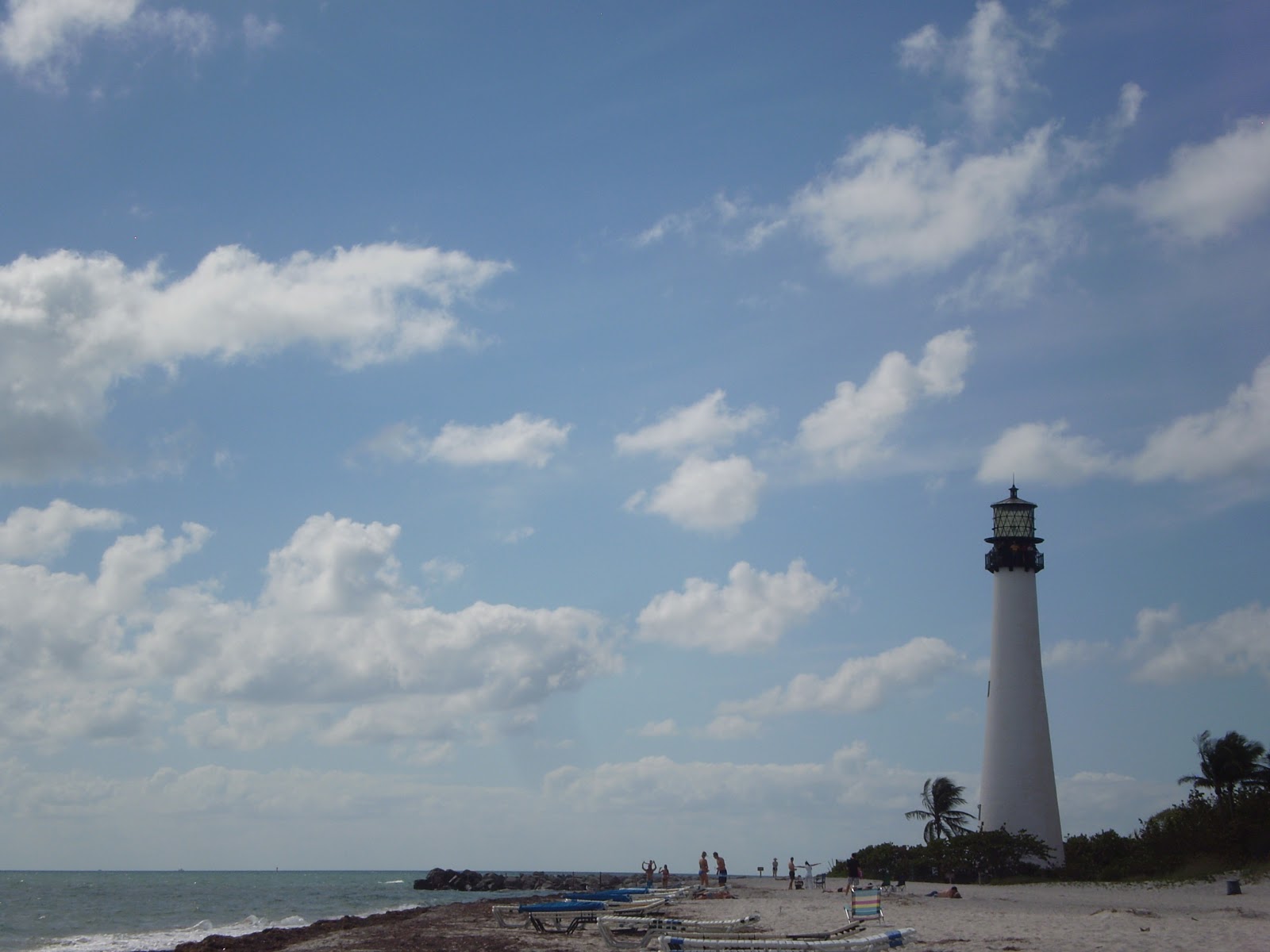
Cape Florida Light, Key Biscayne


Reporter depicts events surrounding Haiti earthquake

Reporter depicts events surrounding Haiti earthquake

By Michael Deibert

The Miami Herald

The Big Truck That Went By: How the World Came to Save Haiti and Left Behind a Disaster

Jonathan M. Katz, Palgrave Macmillan, 320 pages, $26.00

(Please read the original article here)

Jonathan M. Katz’s new book about the aftermath of Haiti’s devastating earthquake in 2010 is fascinating but frustrating. An Associated Press reporter who lived in the country for two years before the disaster, Katz brings an on-the-ground flavor to his depiction of events that is more vivid than those in the more ponderous tomes published in the wake of the calamity.

Katz’s description of the day of the earthquake — a day that could have killed him — is wrenching and terrifying, and his descriptions of the often-callous diplomacy in its aftermath are bitterly convincing. His minute dissection of the failure of most of the promised aid and the misdirection of much of what did arrive is a valuable contribution to understanding how the international community should respond to such crises in the future. Even more chilling is his account of the indifference and subsequent obfuscation of the United Nations mission in Haiti and the fact that its troops introduced a cholera epidemic to the country that killed at least 7,000 people.

But Katz’s sharp lens turns fuzzier when he writes about the Haitians themselves. Early on, he states that he relied on his fixer — a driver/translator/guide — “for everything” during his time in Haiti, and so the account we see is what that fixer showed him, not the account of a journalist venturing forth to immerse himself in the country on its own terms. That’s a pity; Katz is a talented writer, and surely he had interesting thoughts about the subject. His window into Haiti’s byzantine political culture also seems to come from a single source, a former government minister who cannot on his own puzzle out the entire riddle of Haiti’s venomous political landscape.

Katz’s desire to see straight lines where tortuous twists and turns lie means that he tends to oversimplify complex situations. This habit become most problematic when he tries to assess Haiti’s history before he got there. Puzzlingly, nowhere in The Big Truck That Went By does he mention one of the events that probably more than any other destroyed Haiti’s rural agriculture and accelerated the urban migration to the destined-to-be-wrecked capital: a U.S.- Canadian funded program that, in the 1980s, succeeded in destroying 1.2 million of the Kreyol pigs that formed the backbone of the peasant economy.

Legislative elections in 2000 that saw journalists and opposition politicians murdered and their homes and party headquarters burned down are said to have suffered from “alleged fraud.” The chronology of the late-2003/early-2004 armed rebellion that (along with massive street demonstrations) would eventually bring down the government of then-President Jean-Bertrand Aristide is also fudged, with Katz blaming the action on a “small band of well-armed rebels.” In fact, the movement began among a street gang of former loyalists in the northern city of Gonaives, incensed in their belief that Aristide had murdered their chieftain.

Even given Katz’s admirable doggedness as a journalist, there doesn’t seem to be a great deal of love for Haiti in this book. Not for its mist-shrouded mountains, its azure coastal waters, the seductive gingerbread architecture that still rears up unexpectedly in its provincial towns or — with the exception of his fixer and the story of an earthquake-displaced family he movingly chronicles — the Haitians themselves. The Haitians in fact seem to rather irritate Katz, constantly bending his ear with unwanted conversations to the point where he can “hardly ask for directions.” At one moment, he admits that, despite having lived in the country for almost three years, he had rarely “let his guard down” with Haitians, which translates into a lack of intimacy with and insight about the people at the heart of the story.

Katz is a writer of considerable talent, with an often mordant and memorable turn of phrase. Had he schooled himself more thoroughly in Haiti’s history and immersed himself to a greater extent among its people before setting pen to paper, he could have produced a knockout of a book. Despite its many virtues, ultimately The Big Truck That Went By represents another example of what Katz himself exposes so thoroughly of the international community’s involvement with Haiti: Something of a missed opportunity.


Michael Deibert is the author of Notes from the Last Testament: The Struggle for Haiti (Seven Stories Press) and the forthcoming Democratic Republic of Congo: Between Hope and Despair (Zed Books).

Monday, December 31, 2012

End of the year


Farewell 2012, with all your tragedies and triumphs. Bienvenido, 2013.

Wednesday, December 26, 2012

2012: A Reporter's Notebook of the Year Gone By


This past year, my attention was sharply focused on two places near and dear to my heart: the Caribbean nation of Haiti and the Great Lakes region of Central Africa. Though I was not as prolific in churning out articles as I have been in the past, with my attention largely focused on completing my forthcoming book on the Democratic Republic of Congo and commencing work on a new book looking at Northern Mexico, I hope that this oeuvre will nevertheless be useful for those of you trying to make sense of this often-tangled world we live in.

With hopes for peace, both personal and geopolitical, for all in 2013.  

All best, 

MD


Letter from Haiti for the Huffington Post (28 November 2012)

The Fall of Goma for the Huffington Post (20 November 2012)

Oil discovery ignites political tensions in Uganda for fDi Intelligence (11 April 2012)    

After Charles Taylor, Justice for Haiti? for the Huffington Post (26 April 2012) 

How Invisible Children's Kony 2012 Will Hurt - And How You Can Help - Central Africa for the Huffington Post (9 March 2012)

The Problem with Invisible Children's "Kony 2012" for Huffington Post (7 March 2012)

North Kivu’s False Peace for African Arguments (29 February 2012) 

In northern Uganda, a difficult peace for Le Monde diplomatique (26 February 2012)


Wednesday, December 19, 2012

Books in 2012: A Personal Selection

Though intense work on my forthcoming book Democratic Republic of Congo: Between Hope and Despair (Zed Books) and a new project looking at Mexico meant that I wasn’t able to read as much for pleasure as I ordinarily would (something I hope to remedy in the coming year), some interesting tomes nevertheless crossed my radar. Here are some of the most intriguing of them.  

With all best wishes for 2013,  

MD

A Man of the People by Chinua Achebe  

The Nigerian author’s bitter and brilliant 1966 novel about “the corroding effect of privilege” in post-independence Nigeria sees Achebe turning his sharp eye to the acquisitiveness and moral turpitude of the country’s political elite to nearly as great an impact as he examined the destruction of traditional society in a more famous novel, 1958’s Things Fall Apart.

Up Above the World by Paul Bowles   

Chilly, distant and more than a little strange, the American author’s take on Guatemala reminds one of the lineage of U.S. literature that traces back to Edgar Allan Poe, and how the knowledge that comes from actually being in the world, as opposed to just writing about it, adds to the power of the printed page.

Kitchen Confidential: Adventures in the Culinary Underbelly by Anthony Bourdain   

At times overly-garrulous but nevertheless entertaining and enjoyable, Anthony Bourdain’s tale of a misspent youth passed between cuisine high and low was something I have been wanting to get around to reading for a long time and am glad that I finally did.

Don't Sleep, There Are Snakes: Life and Language in the Amazonian Jungle by Daniel Everett  

A linguistic detective story and a thrilling and respectful account of the author’s years living among the Pirahã in the Brazilian Amazon, this book shows how even the most arcane academic pursuits can be riveting in the rights hands. Though the Pirahã can, quite frankly, sometimes come off as petty, vengeful, cachaça-swilling brutes, Everett’s hard-won insistence that we meet them on their own terms is a refreshing antidote to armchair academia posing as insight. A most unique and enjoyable read.

Kings of Cocaine: Inside the Medellin Cartel - An Astonishing True Story of Murder Money and International Corruption By Guy Gugliotta and Jeff Leen   

An engrossing account of the early to mid period Medellín cartel - Pablo Escobar., Jorge Luis Ochoa Vázquez y su familia, José Gonzalo Rodríguez Gacha  and Carlos Lehder - and their American enablers and Colombian and American pursuers. Published back in 1989, the book hearkens back to the days when journalists, well, actually knew something about the subjects they wrote books about. 

Angola from Afro-Stalinism to Petro-Diamond Capitalism by Tony Hodges   

A highly informative if often rather dry account of Angola post-1975 independence to the dawn of the 21st century.

 Beyond the Mexique Bay by Aldous Huxley  

Interesting if often somewhat unpleasantly misanthropic portrait of the writer’s travels through Mexico and Guatemala. Huxley seems as if he would have been a most disagreeable traveling companion: Pissy, prissy, at time unthinkingly bigoted and always, it seems, pining for dear old  England.

Michael Manley: The Making of a Leader by Darrel E. Levi  

An illuminating biography of the nearly-forgotten leader of Jamaica’s People’s National Party, this now-sadly-out-of-print portrait is sympathetic but never hagiographic, recalling such forgotten bits as the sadistic brutality of Manley’s Jamaican education and his brief stint as a journalist, and casting a light back to a time when Jamaica was an important player on the regional stage.

The Rwanda Crisis : History of a Genocide by Gérard  Prunier   

Far more authoritative than Philip Gourevitch’s better-known We Wish to Inform You That Tomorrow We Will Be Killed with Our Families, this book by one of the world’s greatest living Africa scholars looks at the background of one of the last century’s great crimes and why the world failed to stop it.

Defeat is the Only Bad News: Rwanda Under Musinga, 1896-1931 by Alison Liebhafsky des Forges  

As an authoritative account of the reign of the Rwandan monarch Yuhi V (born Yuhi Musinga), this book by one of the world’s great Africa scholars, whose life was tragically cut short, examines the complex links of Tutsi royalty with at first German and then Belgian colonial powers in Rwanda.

Curfewed Night: One Kashmiri Journalist's Frontline Account of Life, Love, and War in His Homeland by Basharat Peer  

A welcome addition to the dearth of literature on the conflict in India-controlled Kashmir by the Kashmiris themselves, Peer’s book nevertheless sometimes reads like confusingly-organized journalist’s notes in search of unifying thread, robbing the overall narrative of any great cumulative emotional impact. Peer is particularly effective when writing about his immediate circle of family and friends, though, and the book adds some sickening details of India’s excesses in its most restive region but, to my mind, the most authoritative Kashmiri voice on the conflict remains the late poet Agha Shadid Ali, whose collection The Country Without a Post Office was one of the highlights of my 2010 reading season.

Saturday, December 08, 2012

Friday, November 30, 2012

Letter from Haiti

Letter from Haiti 

By Michael Deibert

The Huffington Post

(Please read the original article here)

During late November, the clouds hung low over Port-au-Prince, pregnant with the threat of rain. When it did issue forth, life in Haiti's overpopulated capital, partially destroyed in a January 2010 earthquake but still vibrant between the Caribbean Sea and looming mountains, continued irrepressibly on. Moto-taxi drivers plied the streets in their jaunty raincoats, and people continued hawking anything there was to sell under any surface providing shelter from the deluge.

In the middle of one Saturday afternoon, with clouds rumbling down from the mountainside, a group of about 200 young men commandeered the central Place St. Pierre square in the tony suburb of Petionville, halting traffic and periodically hurling bottles in various directions (one of which shattered at my feet). The lads thumped their chests for about three hours before moving on. Their message was that life was too expensive for people in Haiti and that Haiti's President Michel Martelly, whom they said they had previously supported, wasn't doing enough to ameliorate the situation.

Martelly, in his previous life perhaps the most well-known (and most frequently cross-dressing) purveyor of the sinuous Haitian music known as konpa and popularly known as Sweet Micky or Tèt Kale (Bald Head), was not even in the country at the time, a fact not lost on the protesters.

In office since May 2011, Martelly was winding up a long trip to Europe during which he addressed the European Parliament, attended the Ibero-American Summit in Spain and met with the Pope at the Vatican. He was even absent from Haiti during the must-attend 18 November anniversary of the Battle of Vertières, the 1803 clash during which the rebel Haitian army defeated the French near the northern city of Cap-Haïtien and thus paved the way for Haiti's declaration of independence soon thereafter.

"He wants to work well for the people," said a middle-aged taxi driver named Jackson plying the road near the airport, summing up popular sentiment. "But the problem is his entourage."

Elected to succeed René Préval, the only democratically-elected president in Haiti's 208 year history to finish his term in office (a feat the wily, white-bearded Préval managed twice), the political novice Martelly inherited a to-do list that would have daunted even the most skilled politico.

Much of the country's capital was leveled and some 200,000 people believed killed in the January 2010 earthquake, which at one point had left at least 1.5 million people homeless. Tent encampments dotted the capital and its environs and a cholera epidemic, almost certainly brought to the country by the rather-unloved UN peacekeeping mission in place since the 2004 ouster of President Jean-Bertrand Aristide, has thus far killed more than 7,500 people.

The most basic services and healthcare remain out of reach of much of the nation's 10 million inhabitants, scattered in far-off provincial districts reached by badly decayed roads. A gradual diminution of Haiti's security situation since the tumultuous ballot that led to Martelly's election culminated last month with the spectacular arrest of Clifford Brandt, scion of one of Haiti's wealthiest families, as the alleged mastermind behind a long-running kidnapping ring.

Also arrested as part of the gang was the commander of a security unit from Martelly's National Palace (there has been no suggestion the president himself was involved), who entered prison as Calixte Valentin, a Martelly advisor accused of murder, exited it. Former members of the country's army, demobilized but not constitutionally disbanded by Aristide in 1995, continue to agitate for the force's reinstatement despite the existence of a police force - the Police Nationale d'Haïti or PNH - currently numbering some 10,000 recruits. A battle over the composition of the country's electoral council has raged for months.

"A stabilization process is taking place albeit a fragile one," says Mariano Fernández, the Chilean diplomat who heads the UN's peacekeeping mission, known by its acronym MINUSTAH, which is envisioned to be scaled back to around 6,300 military personnel in coming months. "We continue planning to reduce and reconfigure MINUSTAH in the coming years depending on the stability of the conditions."

The last caveat is an important one. Haiti's security forces have enjoyed a steadily-improving reputation since the 2006 inauguration of Martelly's predecessor Préval. It has been a marked change from Aristide's 2001-2004 tenure, when politically-connected partisans were inserted into the PNH regardless of their competency or culpability in various crimes, or that of a 2004-2006 interim government when police often made little distinction between armed pro-Aristide gangs and ordinary residents of the capital's poorer neighborhoods.

Until recently, the PNH were headed by Mario Andrésol, widely regarded as one of the most honest and competent officials in the country and who was replaced by Gotson Aurélus in August. Since then, something of a delicate realignment has been taking place. It is widely believed that Secretary of State for Public Security Reginald Delva exercises more operational control over the PNH than Minister of Justice Jean Renel Sanon, his nominal boss. A former senator, Joseph Lambert, now a Martelly advisor, is also spoken of as wielding influence beyond what one would expect.

Though the Brandt arrest was greeted with a gasp in much of the international community (this is, after all, the strata of society most international actors interact with) in Haiti the view was more circumspect.

"The bourgeois control the police with their money, and a lot of police officers also provide security for businesses and the private sector because there is no control, and they can receive more money for their work," says Pierre Espérance, the Executive Director of the Réseau National de Défense des Droits Humains, Haiti's most prominent human rights organization. "Each kidnapping gang has its connection with the police."

Despite such realities, one of Martelly's chief plans of attack appears to be an attempt to re-band Haiti and change its relentlessly negative image from a place solely of natural disaster, coups, misery and death to one of a place open to investment and boasting a vibrant and tourist-friendly culture.

Though this approach has been rather too smugly sneered at by the international chattering class that comments on Haiti, most people I spoke with in the country actually saw its value and supported it in principle, even if they didn't quite understand why the president was spending so much time abroad.

There is some evidence that Martelly's approach may be succeeding. The president, ever the extrovert natural showman, would seem a perfect fit for such a campaign. In July, the president even declared a three day out-of-season Carnaval des fleurs (Carnival of Flowers) designed to highlight the country's flair for music and pageantry. The camps from the central part of the capital have mostly been cleared, but with some to their inhabitants relocated to a windswept moonscape situated on denuded land on a road leading north out of the city

A new industrial park in the country's north - which itself has hardly been free from controversy - was opened in October, with, among others, U.S. Secretary of State Hillary Clinton and British billionaire Richard Branson in attendance. The lure of potential gold reserves in northern Haiti has brought a number of international mining companies, some with questionable records, to stake claims on huge swathes of land, creating economic potential but only of the most fraught kind.

Though the vast overpopulation of the capital - a consequence in part of international economic policies inflicted upon Haiti - helped lead to the vast death toll from the earthquake, the decentralization of economic and political power from Port-au-Prince still remains an agonizingly slow and complex process. Privately, many in Haiti's business community, intensely nationalistic at heart despite their comfortable economic status, complain the country has been "invaded" by foreign companies and non-governmental organizations.

In some economically struggling communities, the feeling is one of hopes delayed if not dashed entirely.

"We liked Martelly and we thought he would help a lot of people," says Pè Nico, a diminutive young man whose moniker ("Father Nico") belies his youthful appearance. "But this neighborhood has always been forgotten."

Pushing 30 years old but looking barely into his 20s and resplendent in a Miami Heat baseball cap, Pè Nico leads an armed faction in the capital's quartier populaire of St. Martin, an area of deeply-rutted roads and at times precarious-looking structures from which the PNH and MINUSTAH appear completely absent.

Pè Nico's baz say they voted - "99%" in their words - for Martelly. In their neighborhood, once a war zone and still subject to occasional bouts of violence, residents have been tending to the Partnership for Peace and Prosperity in Saint Martin, under whose aegis members of the private sector operating in the zone and local community leaders have sought dialogue and improvement in living conditions there. The two sides began talking in 2007 and, even through the earthquake and after, they are still talking. It is perhaps a hopeful sign.

I had known Martelly very slightly in his previous life as Sweet Micky. We spent a memorable evening more than a decade ago cruising through Port-au-Prince in his SUV with a loaded pistol between us as he bemoaned the state of Haiti and the irresponsibility of its leaders both political and economic, a scene depicted in a book I later wrote about the country.

When I visited Haiti in August 2011, just after Martelly's election, I found popular support for the colorful, eccentric president among the pep la, as Haiti's struggling class (which is to say almost everybody) is known, still high.

Despite the eroding of that hope when confronted with the immense challenge of governing Haiti and his own missteps, Haitians still seem to be giving Martelly the benefit of the doubt.
So many factors - rising food prices, civil unrest underwritten by various malefactors, another natural calamity - could change that. But in a country whose leaders have often promoted themselves through terror and abuse, Martelly - whose signature colour is pink - has offered something of a change of tone, however unorthodox.

On my last day in Haiti, purely by chance, my path overlapped with that of Michel Martelly.

Waiting at the airport to board my flight home, I saw Martelly's American Airlines plane fly in from Miami. As if on cue and so apt for a showman, the cloudy gloom that had plagued the capital for days broke and rays of brilliant golden sunshine spilled out of a blue sky. Diplomats, Haitian police officers in their crisp khaki uniforms and every airport worker that could sneak away from their job were standing there to greet him. He was going to be inaugurating a new arrival hall, they told me, then this week he would be leaving again, this time for Cuba.

Martelly disembarked from the plane, his bald head and smiling visage visible among the mostly smaller Haitians.

They cheered.


Michael Deibert's forthcoming book, Democratic Republic of Congo: Between Hope and Despair, will be published by Zed Books in cooperation with the Royal African Society, the International African Institute and the Social Science Research Council. His previous book, Notes from the Last Testament: The Struggle for Haiti (Seven Stories Press, 2005), was praised by the Miami Herald as "a powerfully documented exposé" and by the San Antonio Express-News as "a compelling mix of reportage, memoir and social criticism."