TRADE-AFRICA: EU Seeks to Subdue Competitive China
By Michael Deibert
Inter Press Service
JOHANNESBURG, May 15, 2008 (IPS) - With the ascendance of China as a robust force on Africa's economic and political scene, plans are afoot in the European Union (EU) to pre-empt the Asian nation's dominance on the continent by forming a trilateral partnership that places Europe squarely in the centre.
The idea of a multilateral triumvirate was conceived by Louis Michel, the EU's commissioner for development and humanitarian aid, and seeks to lay out common ground in what has occasionally been a contentious relationship between these three actors.
''There are three fields where the partners can work together: peace and security, infrastructure and natural resources,'' says Veronika Tywuschik, a research assistant at the European Centre for Development Policy Management (ECDPM) in Brussels. The ECDPM is a non-governmental organisation that assists African, Caribbean and Pacific countries with policy processes.
With Michel set to step down as commissioner in 2009, pressure is building for him to come up with a workable platform in the next few months.
A public consultation period which started on April 16 and will end on July 13 this year is seeking to gather a wide variety of views on how the proposed relations should be constructed.
A public consultation document has been released in the form of a questionnaire asking European citizens which sectors the cooperation should focus on and why.
Read the full article here.
Saturday, May 17, 2008


Tuesday, May 13, 2008


Extraction from chaos?
Extraction from chaos?
By Michael Deibert
Foreign Direct Investment
April 10, 2008
Embattled by war and corruption but laden with large deposits of diamonds and copper, DR Congo is largely avoided by investors. Might that change? Michael Deibert reports.
Blessed with natural resources and occupying a vast swath of central Africa as large as the US east of the Mississippi River, the Democratic Republic of Congo is home to some of the word’s largest deposits of diamonds, copper, cobalt and coltan. Despite a fecund climate encompassing everything from dense, nearly impenetrable rainforests to fertile plains, the country has remained one of Africa’s most tragic. Held in the grip of a predatory state culture of corruption and the often nefarious designs of its neighbours and unscrupulous business dealers with little long-term interest in developing its infrastructure, DR Congo has struggled to attract investors.
The country’s president, Joseph Kabila, first assumed office in 2001 following the assassination of his father, Laurent, who led a rebel movement that toppled the 32-year dictatorship of Mobutu Sese Seko.
Elected for the first time during a violent ballot in 2006, President Kabila is an often mute presence on the Congolese political scene, going for weeks at a time without appearing in public. Nevertheless, the government has begun to take small steps to regularise the often anarchic foreign investment climate in the country, and in February completed a review of all international mining contracts, many of which were signed by President Kabila’s father under circumstances of questionable transparency during DR Congo’s 1998-2002 civil war.
Read the full article here.
By Michael Deibert
Foreign Direct Investment
April 10, 2008
Embattled by war and corruption but laden with large deposits of diamonds and copper, DR Congo is largely avoided by investors. Might that change? Michael Deibert reports.
Blessed with natural resources and occupying a vast swath of central Africa as large as the US east of the Mississippi River, the Democratic Republic of Congo is home to some of the word’s largest deposits of diamonds, copper, cobalt and coltan. Despite a fecund climate encompassing everything from dense, nearly impenetrable rainforests to fertile plains, the country has remained one of Africa’s most tragic. Held in the grip of a predatory state culture of corruption and the often nefarious designs of its neighbours and unscrupulous business dealers with little long-term interest in developing its infrastructure, DR Congo has struggled to attract investors.
The country’s president, Joseph Kabila, first assumed office in 2001 following the assassination of his father, Laurent, who led a rebel movement that toppled the 32-year dictatorship of Mobutu Sese Seko.
Elected for the first time during a violent ballot in 2006, President Kabila is an often mute presence on the Congolese political scene, going for weeks at a time without appearing in public. Nevertheless, the government has begun to take small steps to regularise the often anarchic foreign investment climate in the country, and in February completed a review of all international mining contracts, many of which were signed by President Kabila’s father under circumstances of questionable transparency during DR Congo’s 1998-2002 civil war.
Read the full article here.
Friday, May 09, 2008
Back from South Africa
 I returned to Kinshasa from Johannesburg the other days, after what was, for me, a highly instructive and enjoyable two weeks in South Africa.
Initially hoping to have a short break from pretty much three-months non-stop reporting here in Congo, I was yet again reminded of how interconnected our word is when I was presented with the heart-wrenching story of the plight of hundreds of Zimbabwean refugees sleeping rough Joburg’s downtown, and was heartened by the wit and insight of their advocate. Busman’s holiday, as usual.
I ranged not only through the thoroughly salubrious Melville area (where I met up with my old friend and fellow journalist Gretchen Wilson, who has been in South Africa since 2004) but also the heavily-immigrant districts of Hillbrow and Yeoville, where South African tongues such as Zulu and Xhosa mingle with French and Lingala. A visit to Soweto offered the opportunity me see the house where Nelson Mandela, one of the handful of politicians I still have any respect for at all, lived at one time, as well as the Hector Pieterson Museum.
Perhaps no other icon better illustrates the stupid, banal brutality of the apartheid system that governed South Africa from 1948 until 1994 than the image of the lifeless body of schoolboy Hector Pieterson carried by another young boy, Mbuyisa Makhubo, as Pieterson’s sister, Antoinette, wails beside them. Pieterson was killed on June 16, 1976, when thousands of Soweto students were protesting the imposition of the Afrikaans language - the language of South Africa’s apartheid government - as the medium of instruction (along with English) in the country’s predominantly black schools. The killing sparked the Soweto uprising of 1976, an interesting account of which by Harry Mashabela I am currently reading.
While idly browsing through the bookstore at Oliver Tambo airport, I also picked up a copy of the The Bang-Bango Club, the account by the photojournalists Greg Marinovich and Joao Silva of their years, along with fellow photogs Kevin Carter and Ken Oosterbroek, of chronicling the violent era between Nelson Mandela’s release from prison in 1990 and South Africa’s first democratic elections in 1994. It was a time during which, Marinovich and Silva, write, the forces within the country’s white power structure implacably opposed to a genuine democracy used members and affiliates of the Zulu-centered Inkatha Freedom Party as a bludgeon against the multiracial African National Congress in an effort to disrupt or even derail negations and the 1994 ballot that brought Nelson Mandela to power. The book is tough going - the photographers witnessed some truly ghastly violence, Ken Oosterbroek was fatally shot on the job and Kevin Carter later committed suicide - but it is an edifying read as the layers as the deception and collusion of that era’s violence are stripped away before the reader to reveal the naked power-play that was in fact at work. Reading about the constant money struggles of these, some of South Africa’s most well-regarded and courageous photographers, is also heartening for those of us who still do journalism for the love and mission of the craft and, as such, end up sacrificing a great deal in terms of comfort and financial security.
Walked through Kin La Belle again today, which swirls on to its own rhythm, as usual.
Thursday, May 08, 2008
Portrait

My friend Eve Sibley painted a portrait of me when I was still living in New York which I just happened upon online. Not a bad likeness, all things told.
Sunday, May 04, 2008
RIGHTS: In South Africa, Zimbabwean Refugees Find Sanctuary and Contempt
RIGHTS: In South Africa, Zimbabwean Refugees Find Sanctuary and Contempt
By Michael Deibert
Inter Press Service
JOHANNESBURG, May 4, 2008 (IPS) - As the autumn sun sets over South Africa's most populous city, the halls of downtown Johannesburg's Central Methodist Mission fill with weary figures, many far from home, seeking solace within its walls.
On every spare inch of space on the floors and narrow staircase of the mission -- and on the pavement outside -- the destitute curl up to find shelter as best they can from the chill wind that moves between the tall buildings in this city. Mixed in among them every night are hundreds of refugees from South Africa's northern neighbour, Zimbabwe, who have fled their country's slow-motion economic and political implosion.
"We sleep outside in the streets. Sometimes we spend days without eating anything; we spend weeks without working," says Owen Muchanyo, a 23-year-old secondary school teacher of mathematics and science from Chitungwiza, a town south of Zimbabwe's capital, Harare.
He has been in South Africa for three months. "It's better to sleep on the streets, where my life is somewhat safe, than to sleep in a house when my life is in danger."
Read the full article here.
By Michael Deibert
Inter Press Service
JOHANNESBURG, May 4, 2008 (IPS) - As the autumn sun sets over South Africa's most populous city, the halls of downtown Johannesburg's Central Methodist Mission fill with weary figures, many far from home, seeking solace within its walls.
On every spare inch of space on the floors and narrow staircase of the mission -- and on the pavement outside -- the destitute curl up to find shelter as best they can from the chill wind that moves between the tall buildings in this city. Mixed in among them every night are hundreds of refugees from South Africa's northern neighbour, Zimbabwe, who have fled their country's slow-motion economic and political implosion.
"We sleep outside in the streets. Sometimes we spend days without eating anything; we spend weeks without working," says Owen Muchanyo, a 23-year-old secondary school teacher of mathematics and science from Chitungwiza, a town south of Zimbabwe's capital, Harare.
He has been in South Africa for three months. "It's better to sleep on the streets, where my life is somewhat safe, than to sleep in a house when my life is in danger."
Read the full article here.
"We Mustn't Think as South Africans That We Have Won the Day": An interview with Paul Verryn
"We Mustn't Think as South Africans That We Have Won the Day": An interview with Paul Verryn
Inter Press Service
JOHANNESBURG, May 4, 2008 (IPS) - Bishop Paul Verryn, who directs the Central Methodist Mission in Johannesburg, South Africa, has long been on the frontlines of the country's political struggles.
Born in 1952 in the capital city of Pretoria, Verryn came of age during the most contentious days of the fight against apartheid. After completing military training, he entered the ministry, working in the Eastern Cape Province for 11 years.
Verryn's experiences there as the chairman of the Detainees Parents' Support Committee -- which sought to aid the thousands of South Africans detained without trial at the time -- and the murder of anti-apartheid activist Steve Biko while in police custody in August 1977 served as something of a political awakening for the young cleric.
Transferred to the sprawling black settlement of Soweto in Johannesburg in 1987, Verryn has continued to live there until this day.
His criticism of the powerful continued with the advent of democracy in South Africa; many recall his tearful testimony before South Africa's Truth and Reconciliation Commission (TRC) in 1997 regarding the involvement of Winnie Mandela, former wife of anti-apartheid hero and then South African president Nelson Mandela, in the kidnapping and murder of Stompie Moeketsi.
The 14-year-old anti-apartheid activist was seized from Verryn's Soweto mission by Mrs Mandela's bodyguards in 1988, and his battered body later found in a ditch. Winnie Mandela was eventually convicted of involvement in Moeketsi's kidnapping.
Today, as director of the Central Methodist Mission, Verryn has taken up another cause: the plight of immigrants to South Africa from Zimbabwe, a country that has been blighted by political violence and economic degeneration in recent years. Having thrown open the doors of his mission to these new arrivals, he saw the building raided in a controversial police action earlier this year, but has refused stop providing shelter and assistance to the Zimbabweans as they stream southward.
IPS correspondent Michael Deibert sat down with Verryn to hear his thoughts on how the mission was meeting this and other challenges.
Read the full article here.
Inter Press Service
JOHANNESBURG, May 4, 2008 (IPS) - Bishop Paul Verryn, who directs the Central Methodist Mission in Johannesburg, South Africa, has long been on the frontlines of the country's political struggles.
Born in 1952 in the capital city of Pretoria, Verryn came of age during the most contentious days of the fight against apartheid. After completing military training, he entered the ministry, working in the Eastern Cape Province for 11 years.
Verryn's experiences there as the chairman of the Detainees Parents' Support Committee -- which sought to aid the thousands of South Africans detained without trial at the time -- and the murder of anti-apartheid activist Steve Biko while in police custody in August 1977 served as something of a political awakening for the young cleric.
Transferred to the sprawling black settlement of Soweto in Johannesburg in 1987, Verryn has continued to live there until this day.
His criticism of the powerful continued with the advent of democracy in South Africa; many recall his tearful testimony before South Africa's Truth and Reconciliation Commission (TRC) in 1997 regarding the involvement of Winnie Mandela, former wife of anti-apartheid hero and then South African president Nelson Mandela, in the kidnapping and murder of Stompie Moeketsi.
The 14-year-old anti-apartheid activist was seized from Verryn's Soweto mission by Mrs Mandela's bodyguards in 1988, and his battered body later found in a ditch. Winnie Mandela was eventually convicted of involvement in Moeketsi's kidnapping.
Today, as director of the Central Methodist Mission, Verryn has taken up another cause: the plight of immigrants to South Africa from Zimbabwe, a country that has been blighted by political violence and economic degeneration in recent years. Having thrown open the doors of his mission to these new arrivals, he saw the building raided in a controversial police action earlier this year, but has refused stop providing shelter and assistance to the Zimbabweans as they stream southward.
IPS correspondent Michael Deibert sat down with Verryn to hear his thoughts on how the mission was meeting this and other challenges.
Read the full article here.
Thursday, May 01, 2008
DRC: With Rebel Leader's Indictment, a Tentative Step to Accountability
DRC: With Rebel Leader's Indictment, a Tentative Step to Accountability
By Michael Deibert
Inter Press Service
JOHANNESBURG, May 1, 2008 (IPS) - The indictment against a militia leader whose alleged abuses span the Democratic Republic of Congo's war-ravaged east was finally made public at the end of April, almost two years after being delivered under seal to war crimes prosecutors.
The International Criminal Court (ICC) alleges that Bosco Ntaganda "committed war crimes of enlistment and conscription of children under the age of 15", using the children "to participate actively in hostilities in Ituri, in the Democratic Republic of the Congo, from July 2002 until December 2003."
Formerly the chief of military operations for the Union des Patriotes Congolais (Union of Congolese Patriots, UPC), Ntaganda now serves as military chief of staff of the Congrès National pour la Défense du Peuple (National Congress for the Defence of the People, CNDP).
The warrant was made being made public now because it would "not endanger the witnesses of the DRC cases" at the present moment, the ICC said in a statement.
Read the full article here.
By Michael Deibert
Inter Press Service
JOHANNESBURG, May 1, 2008 (IPS) - The indictment against a militia leader whose alleged abuses span the Democratic Republic of Congo's war-ravaged east was finally made public at the end of April, almost two years after being delivered under seal to war crimes prosecutors.
The International Criminal Court (ICC) alleges that Bosco Ntaganda "committed war crimes of enlistment and conscription of children under the age of 15", using the children "to participate actively in hostilities in Ituri, in the Democratic Republic of the Congo, from July 2002 until December 2003."
Formerly the chief of military operations for the Union des Patriotes Congolais (Union of Congolese Patriots, UPC), Ntaganda now serves as military chief of staff of the Congrès National pour la Défense du Peuple (National Congress for the Defence of the People, CNDP).
The warrant was made being made public now because it would "not endanger the witnesses of the DRC cases" at the present moment, the ICC said in a statement.
Read the full article here.
Friday, April 25, 2008
Hillbrow Vibes
Having arrived in Johannesburg on Monday, I have thus far found the city, despite its significant social ills, to be a vibrant, dynamic face of the mosaic that is modern day South Africa, and, as such, much to my liking. Glorious, crisp clear fall weather has complimented exploring nicely. After the ceaseless grind of Kinshasa, the restaurants, bookstores, good roads and ability to speak English are also welcomed breaks. Yesterday was an opportunity to dine with a colleague from the Inter Press Service and discuss international coverage of Africa and other issues, and today I will begin to wade into the situation of Zimbabwean exile politics and the treatment of Zimbabwean refugees by the government here. And hopefully a visit to House of Nsako will find it's way into the mix, as well.
Author's note: The title of this post is a naked steal from the opening song to the album Rhythm in Blue by the great T.K. Blue, referring as it does to the Jozi neighborhood of the same name. I first saw T.K. play with Randy Weston in New York a few years back, and later became friendly with him after seeing him play at a Darfur benefit concert. The album in question is a bracing tour of African and Caribbean rhythms in a modern jazz setting, and I highly recommend it to anyone interested in the genre.
Author's note: The title of this post is a naked steal from the opening song to the album Rhythm in Blue by the great T.K. Blue, referring as it does to the Jozi neighborhood of the same name. I first saw T.K. play with Randy Weston in New York a few years back, and later became friendly with him after seeing him play at a Darfur benefit concert. The album in question is a bracing tour of African and Caribbean rhythms in a modern jazz setting, and I highly recommend it to anyone interested in the genre.
Thursday, April 24, 2008
HEALTH-DRC: Water Everywhere, But Is It Safe To Drink?
HEALTH-DRC: Water Everywhere, But Is It Safe To Drink?
By Michael Deibert
Inter Press Service
KINSHASA, Apr 24, 2008 (IPS) - The rain falls in battering sheets, rolling eastward along the Congo River through Kinshasa, capital of the Democratic Republic of Congo (DRC). It is midday, but the sky turns black and soon the potholed streets of this decrepit yet vibrant metropolis are filled with pond-sized puddles, many of them larger than the cars that traverse them.
April is the beginning of the rainy season for the DRC's eastern provinces, a time when perpetually more water gets dumped on an already drenched region.
But despite an abundant rain supply and churning rivers, access to clean water has been a persistent problem for this Central African nation. As large as Western Europe, the DRC is still attempting to pick up the pieces after a decade of war and attendant upheaval that claimed the lives of over five million people, according to recent figures from the International Rescue Committee (IRC) relief organisation
Read the full article here.
By Michael Deibert
Inter Press Service
KINSHASA, Apr 24, 2008 (IPS) - The rain falls in battering sheets, rolling eastward along the Congo River through Kinshasa, capital of the Democratic Republic of Congo (DRC). It is midday, but the sky turns black and soon the potholed streets of this decrepit yet vibrant metropolis are filled with pond-sized puddles, many of them larger than the cars that traverse them.
April is the beginning of the rainy season for the DRC's eastern provinces, a time when perpetually more water gets dumped on an already drenched region.
But despite an abundant rain supply and churning rivers, access to clean water has been a persistent problem for this Central African nation. As large as Western Europe, the DRC is still attempting to pick up the pieces after a decade of war and attendant upheaval that claimed the lives of over five million people, according to recent figures from the International Rescue Committee (IRC) relief organisation
Read the full article here.
Sunday, April 20, 2008
The Fruits of Reform
The Fruits of Reform
Foreign Direct Investment
Mozambique, whose history has been blighted by a long liberation struggle and years of civil war, is starting to reap the benefits of recent macroeconomic reforms with a new wave of projects in its virtually untouched biofuel and tourism sectors, writes Michael Deibert.
For a country once so tumultuous that its leaders opted to adorn the national flag with the image of an AK-47, and so economically recalcitrant that widespread nationalisation of private industries was the order of the day, Mozambique has made great strides in liberalising its markets and attracting foreign investment in recent years.
Read the full article here.
Foreign Direct Investment
Mozambique, whose history has been blighted by a long liberation struggle and years of civil war, is starting to reap the benefits of recent macroeconomic reforms with a new wave of projects in its virtually untouched biofuel and tourism sectors, writes Michael Deibert.
For a country once so tumultuous that its leaders opted to adorn the national flag with the image of an AK-47, and so economically recalcitrant that widespread nationalisation of private industries was the order of the day, Mozambique has made great strides in liberalising its markets and attracting foreign investment in recent years.
Read the full article here.
Friday, April 18, 2008
On the passing of Aimé Césaire
 Aimé Césaire, the Martiniquen writer who represented the best tradition of the author as public intellectual, passed away yesterday in Fort-de-France.
Though not hugely well-know in the English-speaking world, and though defying easily categorization, Césaire's intellectual leanings can be looked upon in some ways as an outgrowth of the Négritude movement in the French Caribbean, which sought to look back to African traditions for cultural legitimacy rather than to those of the region’s colonial powers, and which was arguably first started by the Haitian educator and ethnologist Jean Price-Mars, whose book Ainsi parla l’Oncle (Thus Spoke Uncle), was one of the current's earliest key texts. Ironically, perhaps, Césaire was deeply immersed in the politics of Martinique, a French department, and of France itself. As a student in Paris, he helped found L'Étudiant Noir, an important literary review and a precursor to the later literary journal, Tropiques.
Césaire, who served in France's Assemblée nationale from 1946 to 1956 and from 1958 to 1993, also served a nearly uninterrupted stint as mayor of Fort-de-France from 1945 until 2001. A one-time Communist, Césaire broke with the Communist Party following the Soviet invasion of Hungary in 1956, an example of moral principle trumping political expediency that many progressives would do well to consider today.
His most famous work was arguably the long poem Cahier d'un retour au pays natal.
He also managed to have an airport named after him.
POLITICS-DRC: Cautious Calm Settles Over War-scarred Ituri Region
POLITICS-DRC: Cautious Calm Settles Over War-scarred Ituri Region
By Michael Deibert
Inter Press Service
BOGORO, April 17, 2008 (IPS) - Wading through the chest-high grass outside of this hamlet in north-eastern Democratic Republic of Congo, Mathieu Nyakufa gestures to the bones -- still bleaching in the sun -- of those who have been lost to the country's wars.
"I was living just down here in the valley," the 52-year-old farmer says of one terrible morning in February 2003. "They were killing people with guns, with machetes, with spears and arrows. I escaped because I saw people running in my direction. Three of my children were killed in my own house."
An estimated 200 civilians were killed in Bogoro, located in the heart of the Ituri region, when combatants of the Forces de Résistance Patriotique d'Ituri (Patriotic Resistance Forces of Ituri, or FRPI), a militia dominated by the Ngiti and Lendu ethnic groups, attacked this scattered collection of thatched-roof huts and mud dwellings. At the time, Bogoro was a stronghold of the Union des Patriotes Congolais (Union of Congolese Patriots, UPC), an armed group loyal to the Gegere and Hema tribes.
"The UPC told me, 'Papa, run away, don't wait, because the Lendu are killing your people'," says Nyakufa.
The Bogoro massacre was one of many such slaughters that occurred in Ituri, which contains some of the world's most valuable deposits of gold and reserves of timber. A brutal extension of the civil war which engulfed this vast African nation from 1998 until 2003, the conflict in Ituri saw neighbouring Uganda and Rwanda arm militias in an ever-shifting web of alliances, as much for their own designs on Congo's natural resources as for any political solidarity with the Congolese.
Read the full article here.
By Michael Deibert
Inter Press Service
BOGORO, April 17, 2008 (IPS) - Wading through the chest-high grass outside of this hamlet in north-eastern Democratic Republic of Congo, Mathieu Nyakufa gestures to the bones -- still bleaching in the sun -- of those who have been lost to the country's wars.
"I was living just down here in the valley," the 52-year-old farmer says of one terrible morning in February 2003. "They were killing people with guns, with machetes, with spears and arrows. I escaped because I saw people running in my direction. Three of my children were killed in my own house."
An estimated 200 civilians were killed in Bogoro, located in the heart of the Ituri region, when combatants of the Forces de Résistance Patriotique d'Ituri (Patriotic Resistance Forces of Ituri, or FRPI), a militia dominated by the Ngiti and Lendu ethnic groups, attacked this scattered collection of thatched-roof huts and mud dwellings. At the time, Bogoro was a stronghold of the Union des Patriotes Congolais (Union of Congolese Patriots, UPC), an armed group loyal to the Gegere and Hema tribes.
"The UPC told me, 'Papa, run away, don't wait, because the Lendu are killing your people'," says Nyakufa.
The Bogoro massacre was one of many such slaughters that occurred in Ituri, which contains some of the world's most valuable deposits of gold and reserves of timber. A brutal extension of the civil war which engulfed this vast African nation from 1998 until 2003, the conflict in Ituri saw neighbouring Uganda and Rwanda arm militias in an ever-shifting web of alliances, as much for their own designs on Congo's natural resources as for any political solidarity with the Congolese.
Read the full article here.
Thursday, April 17, 2008
Two photojournalist websites of note
Though the trend in the news business these days is to an ever-more streamlined (i.e. mercilessly gutted) approach to news gathering, particularly from developing countries, I, for one, have always maintained the belief that countries such as the Democratic Republic of Congo, where I now find myself, should be covered with every bit the dedication and seriousness afforded to Europe and North America.
During my years in the field reporting, I have often been fortunate enough to come across some talented photographers whom I was able to work with or, if not to directly collaborate with, whose work I was able to appreciate for its documentary and aesthetic appeal as it chronicled situations that I myself was witnessing. Photographers such as Rodrigo Abd from the Associated Press, whom I met at the exhumation of a massacre site in Guatemala, or Noelle Théard, whom I met on the front lawn of Haiti’s National Palace on January 1, 2004, reminded me, despite the desire of some editors for journalists and photographers to wear the same hat, that expertise in the written word and the visual image rarely run together, and that there are many photographers out there whose expertise far outstrips my own meager efforts in the field. The two disciplines, writing and photography, in my view run on two different engines, so it is always good to find competent, like-minded souls to produce a photographic record while I am busy recording the history of a place.
To that end, I would like to direct readers to a pair of newish websites by photographers whose acquaintance I’ve made over the years.
I first sat down to dinner with Thos Robinson at a little café in Astoria, Queens in New York City some years ago, just before Thos made his first of what would become many trips to Haiti and the Dominican Republic, empathetically documenting the lives of Haitians living on both sides of the border. Coming after a sojourn in Palestine, Thos’ time in Haiti, during some of which we worked together, has seen him producing a very impressive catalogue of black and white images that chronicle a country’s tentative moves toward peace and stability in the early days of the second presidency of René Préval. Thos’ website can be viewed here.
Andrew McConnell and I ran into one another earlier this year in Goma, in the eastern Democratic Republic of Congo, and from there ranged far and wide across North Kivu province for several days, covering the conflict and the displacement of the population there. Andrew’s chronicle of his travels in Europe, Asia and Africa can be viewed on his website, while a special feature on the continuing crisis in eastern DRC that Andrew composed, containing some haungting images of the the Forces Démocratiques de Libération du Rwanda at one of their base camps, can be viewed at the World Picture News website.
During my years in the field reporting, I have often been fortunate enough to come across some talented photographers whom I was able to work with or, if not to directly collaborate with, whose work I was able to appreciate for its documentary and aesthetic appeal as it chronicled situations that I myself was witnessing. Photographers such as Rodrigo Abd from the Associated Press, whom I met at the exhumation of a massacre site in Guatemala, or Noelle Théard, whom I met on the front lawn of Haiti’s National Palace on January 1, 2004, reminded me, despite the desire of some editors for journalists and photographers to wear the same hat, that expertise in the written word and the visual image rarely run together, and that there are many photographers out there whose expertise far outstrips my own meager efforts in the field. The two disciplines, writing and photography, in my view run on two different engines, so it is always good to find competent, like-minded souls to produce a photographic record while I am busy recording the history of a place.
To that end, I would like to direct readers to a pair of newish websites by photographers whose acquaintance I’ve made over the years.
I first sat down to dinner with Thos Robinson at a little café in Astoria, Queens in New York City some years ago, just before Thos made his first of what would become many trips to Haiti and the Dominican Republic, empathetically documenting the lives of Haitians living on both sides of the border. Coming after a sojourn in Palestine, Thos’ time in Haiti, during some of which we worked together, has seen him producing a very impressive catalogue of black and white images that chronicle a country’s tentative moves toward peace and stability in the early days of the second presidency of René Préval. Thos’ website can be viewed here.
Andrew McConnell and I ran into one another earlier this year in Goma, in the eastern Democratic Republic of Congo, and from there ranged far and wide across North Kivu province for several days, covering the conflict and the displacement of the population there. Andrew’s chronicle of his travels in Europe, Asia and Africa can be viewed on his website, while a special feature on the continuing crisis in eastern DRC that Andrew composed, containing some haungting images of the the Forces Démocratiques de Libération du Rwanda at one of their base camps, can be viewed at the World Picture News website.
Michael Deibert responds to Peter Hallward
Michael Deibert responds to Peter Hallward
On my blog last month, I posted a lengthy review of the book Damming the Flood: Haiti, Aristide and the Politics of Containment, written by Middlesex University Professor Peter Hallward [1].
As I noted at the time, the work - composed chiefly of interviews with supporters of former Haitian president Jean-Bertrand Aristide and often unreliably-referenced secondary source material - appeared to represent an attempt by Hallward, who had visited Haiti only twice during its writing and never bothered to learn to speak its poetic native Kreyol language, to excuse the excesses of Aristide’s 2001-2004 second mandate and argue that the president, far from being an exacerbating force in Haiti’s multitude of problems, was instead the hapless victim of a vast plot by local and foreign adversaries. Having first visited Haiti in 1997, and reported on the country for a variety of media outlets from 2000 until 2006, I knew Hallward’s thesis to be an incorrect one, and set about outlining what I found to be some of the more pernicious falsehoods with which he attempted to back it up.
This month, Peter Hallward, writing on the website Haiti Analysis [2], itself a veritable font of fanatical pro-Aristide propaganda, chose to respond to my critique of his book in an article that was subsequently reprinted on the website of MRZine.
Preoccupied as I am with reporting on the struggles of disenfranchised and disadvantaged peoples from often remote and violent locations (Democratic Republic of Congo, Cote d’Ivoire, India-administered Kashmir, Haiti itself), I confess that I haven’t had the time or inclination to keep up with every self-justifying bit of moral and intellectual acrobatics performed by the affluent foreign commentators that have comprised the bulk of support for Haiti’s disgraced former president since his ouster in February 2004. Given the array of very serious problems that confront Haiti these days - a dysfunctional parliament, spiraling food costs and attendant demonstrations, rampant deforestation and environmental degradation - the attention of those concerned with the country’s fate may indeed also be better focused elsewhere rather than on a protracted back-and-forth between two foreign intellectuals over a book of negligible interest or value to alleviating those ills.
However, briefly, in the interest of correcting the historical record which he seems content to muddy, I will respond to Peter Hallward’s response of my review of his book here.
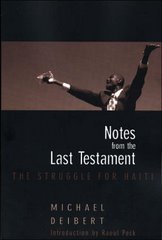
Though Hallward writes that my 2005 book, Notes from the Last Testament: The Struggle for Haiti (Seven Stories Press) was “applauding the overthrow” of the second Aristide government, a more accurate characterization might be that it was mourning the fraying of the broad social-democratic coalition that ousted the Duvalier dictatorship for power in 1986 and first brought Aristide to office in 1990, along with criticizing Aristide’s own role in that collapse. Having seen first hand the hopes that Haiti’s poor majority had invested in Aristide, and the way those hopes were cynically betrayed, far from glee and joy at the events of the president’s second mandate, to me the only appropriate response seemed to be sadness and regret at the waste of opportunity and human potential. Writers like Peter Hallward don’t seem to give much credence to emotions such as those when strident sloganeering will do, but I have found in my years in Haiti that political life there exists, not in black and white, but in varying shades of grey, where today’s democrat can be tomorrow’s despot and yesterday’s oppressor can be viewed as today’s unlikely liberator.
Hallward states in his response that I suggested that he deliberately misquoted Anne Hastings, the director of Haiti's lauded micro-credit institution Fonkoze, as coming out in full-throated defense of the Aristide government in his interview with her. Though Hallward may be bothered by a guilty conscience at this point, I said nothing of the sort. Writing to Hasting, who I have known for the better part of the decade as someone who stayed above the fray of Haitian politics to better continue Fonkoze‘s work of aiding Haiti‘s poor, I simply asked whether or not Hallward’s quotation of her was accurate. She responded in a 27 January 2008 email as follows [3]:
I don't think I have ever said or ever would say that. I am always very careful to say I don't know whether there is substance or not. It is up to the Haitian people to make their decision.
In his response to my review, Peter Hallward confirms that his quotation of Anne Hastings was erroneous. Whether it was intentional or not, I have no idea, but it does point to what, in my view, is a troubling pattern in Hallward’s work. Though I can’t claim omniscience in decoding Peter Hallward’s intentions when it comes to presenting such a curiously selected litany of false information as objective history, I do find, given his stated sympathies to the Aristide government and the Fanmi Lavalas party before starting his book or even visiting Haiti, that all of his “errors” should conveniently support his erroneous thesis rather suggestive. Nearly every one of the main claims in Damming the Flood - that the 2000 elections that returned Jean-Bertrand Aristide to power were free and fair, that the Aristide government was not actively involved in arming and organizing street gangs to crush its political opposition, that the government still retained a great deal of popular support in late 2003/early 2004 - are false, and demonstrably so, by the historical record as I laid out in my original review.
When Hallward, writes, for instance, that the Réseau National de Défense des Droits Humains (RNDDH) Haitian human rights organization was part of "a very partial list of the recipients of USAID, IFES and/or IRI support" during the years leading up to the 2004 overthrow of Aristide, that is false. In his response to my review, Hallward tries to wriggle out of being caught in this obvious inaccuracy by writing that “NCHR’s receipt of USAID money… (is) a matter of the US Congressional record.” In my reviews of the sources of funding for NCHR Haiti (which later became RNDDH), I have found no evidence of money distributed to the group’s Port-au-Prince office by USAID. Seeking further confirmation, I wrote to Pierre Esperance, the group’s director, and he responded on 10 April 2008 with the following email [4]:
RNDDH has never and will not accepted funds from US government.
Though RNDDH/NCHR did receive funding from organziations such as Christian Aid, the Mennonite Central Committee, the Lutheran World Federation and a one-time grant from the Canadian International Development Agency (CIDA), I still have found no eveidence of the group receiving funding from the United States government.
As to the Hallward’s characterization the massacre of anti-government militants in the northern city of Saint-Marc in February 2004 (along with innocent civilians), as always with Peter Hallward, any vile attack carried out by forces loyal to Jean-Bertrand Aristide was a “clash,” much as the vicious attack on protesting university students on 5 December 2003 (one of the defining moments in the end of Aristide’s second government) was “a brawl.” If Hallward doesn’t view the massacre at least 27 human beings and attendant atrocities such as gang rape which, given the presence of Unite de Securite de la Garde du Palais National d’Haiti personnel and gang members from the capital dressed in police uniforms, was certainly carried out with government knowledge, as a “crime against humanity,” it is hard to know what would qualify as such.
Peter Hallward could have written a perfectly reasonable, factual book outlining why he thought the second Aristide government as it existed deserved to be allowed to finish its mandate, however appalling its excesses, and why the convergence of forces against the president and his political party (many of them thrown together by Aristide’s own actions) would, in the long run, cause even greater harm to Haiti’s poor majority than the violent, corrupt and despotic actors who ruled Haiti from 2001 until 2004.
That is not, however, what Hallward did.
Based on a review of his secondary source material and discussions with some of his primary sources, I have concluded that Hallward, either through intention or through a series of extraordinarily ideologically fortuitous mistakes, time and again printed false information that flies in the face of the documented record and, indeed, the transcripts of his own interviews.
As for Peter Hallward’s statement that I view his book as being written by “an ignorant outsider,” I will simply say this: We are all, those of us of foreign birth who write on Haiti, outsiders to one degree or another. The question is whether or not, that being the case, we operate in good faith when chronicling events in this small, impoverished country. Over the better part of a decade, encouraged by the example of many brave Haitian journalists, I did my best to act in good faith while reporting from a vast array of locales around Haiti about the desire of the Haitian people for a responsive and responsible government to address their legitimate grievances and historic disenfranchisement. I did so often at considerable personal risk and for little or no financial reward. It was the least I owed the long-suffering people there who entrust outsiders such as myself with trying to help the world understand their story.
Finishing Damming the Flood, I believe knowing whether or not Peter Hallward operated in similar good faith is open to debate, but the evidence is not encouraging.
Michael Deibert is the author of Notes from the Last Testament: The Struggle for Haiti (Seven Stories Press).
1. A Review of Peter Hallward’s Damming the Flood: Haiti, Aristide and the Politics of Containment , March 16, 2008.
2. One of the “editors” of Haiti Analysis, a seemingly-eternal graduate student named Jeb Sprague, first announced his presence to me by emailing me (unsolicited) a graphic photo of the bullet-riddled, blood-soaked bodies of a Haitian mother and her children along with a smiley-face emoticon. I was left shrugging that perhaps Sprague suffered from some sort of mental illness, as he viewed the dead mother and her toddlers appropriate material for some sort of cheap joke.
3. Email from Anne Hastings, 27 Janaury 2008
4. Email from Pierre Esperance, 10 April 2008.
(Author's note: This response was submitted to MRZine editor Yoshie Furuhashi who, apparently in the interest of stifling and obscuring discussion on the subject of Haiti, refused to print it. So much for free debate.)
On my blog last month, I posted a lengthy review of the book Damming the Flood: Haiti, Aristide and the Politics of Containment, written by Middlesex University Professor Peter Hallward [1].
As I noted at the time, the work - composed chiefly of interviews with supporters of former Haitian president Jean-Bertrand Aristide and often unreliably-referenced secondary source material - appeared to represent an attempt by Hallward, who had visited Haiti only twice during its writing and never bothered to learn to speak its poetic native Kreyol language, to excuse the excesses of Aristide’s 2001-2004 second mandate and argue that the president, far from being an exacerbating force in Haiti’s multitude of problems, was instead the hapless victim of a vast plot by local and foreign adversaries. Having first visited Haiti in 1997, and reported on the country for a variety of media outlets from 2000 until 2006, I knew Hallward’s thesis to be an incorrect one, and set about outlining what I found to be some of the more pernicious falsehoods with which he attempted to back it up.
This month, Peter Hallward, writing on the website Haiti Analysis [2], itself a veritable font of fanatical pro-Aristide propaganda, chose to respond to my critique of his book in an article that was subsequently reprinted on the website of MRZine.
Preoccupied as I am with reporting on the struggles of disenfranchised and disadvantaged peoples from often remote and violent locations (Democratic Republic of Congo, Cote d’Ivoire, India-administered Kashmir, Haiti itself), I confess that I haven’t had the time or inclination to keep up with every self-justifying bit of moral and intellectual acrobatics performed by the affluent foreign commentators that have comprised the bulk of support for Haiti’s disgraced former president since his ouster in February 2004. Given the array of very serious problems that confront Haiti these days - a dysfunctional parliament, spiraling food costs and attendant demonstrations, rampant deforestation and environmental degradation - the attention of those concerned with the country’s fate may indeed also be better focused elsewhere rather than on a protracted back-and-forth between two foreign intellectuals over a book of negligible interest or value to alleviating those ills.
However, briefly, in the interest of correcting the historical record which he seems content to muddy, I will respond to Peter Hallward’s response of my review of his book here.
Though Hallward writes that my 2005 book, Notes from the Last Testament: The Struggle for Haiti (Seven Stories Press) was “applauding the overthrow” of the second Aristide government, a more accurate characterization might be that it was mourning the fraying of the broad social-democratic coalition that ousted the Duvalier dictatorship for power in 1986 and first brought Aristide to office in 1990, along with criticizing Aristide’s own role in that collapse. Having seen first hand the hopes that Haiti’s poor majority had invested in Aristide, and the way those hopes were cynically betrayed, far from glee and joy at the events of the president’s second mandate, to me the only appropriate response seemed to be sadness and regret at the waste of opportunity and human potential. Writers like Peter Hallward don’t seem to give much credence to emotions such as those when strident sloganeering will do, but I have found in my years in Haiti that political life there exists, not in black and white, but in varying shades of grey, where today’s democrat can be tomorrow’s despot and yesterday’s oppressor can be viewed as today’s unlikely liberator.
Hallward states in his response that I suggested that he deliberately misquoted Anne Hastings, the director of Haiti's lauded micro-credit institution Fonkoze, as coming out in full-throated defense of the Aristide government in his interview with her. Though Hallward may be bothered by a guilty conscience at this point, I said nothing of the sort. Writing to Hasting, who I have known for the better part of the decade as someone who stayed above the fray of Haitian politics to better continue Fonkoze‘s work of aiding Haiti‘s poor, I simply asked whether or not Hallward’s quotation of her was accurate. She responded in a 27 January 2008 email as follows [3]:
I don't think I have ever said or ever would say that. I am always very careful to say I don't know whether there is substance or not. It is up to the Haitian people to make their decision.
In his response to my review, Peter Hallward confirms that his quotation of Anne Hastings was erroneous. Whether it was intentional or not, I have no idea, but it does point to what, in my view, is a troubling pattern in Hallward’s work. Though I can’t claim omniscience in decoding Peter Hallward’s intentions when it comes to presenting such a curiously selected litany of false information as objective history, I do find, given his stated sympathies to the Aristide government and the Fanmi Lavalas party before starting his book or even visiting Haiti, that all of his “errors” should conveniently support his erroneous thesis rather suggestive. Nearly every one of the main claims in Damming the Flood - that the 2000 elections that returned Jean-Bertrand Aristide to power were free and fair, that the Aristide government was not actively involved in arming and organizing street gangs to crush its political opposition, that the government still retained a great deal of popular support in late 2003/early 2004 - are false, and demonstrably so, by the historical record as I laid out in my original review.
When Hallward, writes, for instance, that the Réseau National de Défense des Droits Humains (RNDDH) Haitian human rights organization was part of "a very partial list of the recipients of USAID, IFES and/or IRI support" during the years leading up to the 2004 overthrow of Aristide, that is false. In his response to my review, Hallward tries to wriggle out of being caught in this obvious inaccuracy by writing that “NCHR’s receipt of USAID money… (is) a matter of the US Congressional record.” In my reviews of the sources of funding for NCHR Haiti (which later became RNDDH), I have found no evidence of money distributed to the group’s Port-au-Prince office by USAID. Seeking further confirmation, I wrote to Pierre Esperance, the group’s director, and he responded on 10 April 2008 with the following email [4]:
RNDDH has never and will not accepted funds from US government.
Though RNDDH/NCHR did receive funding from organziations such as Christian Aid, the Mennonite Central Committee, the Lutheran World Federation and a one-time grant from the Canadian International Development Agency (CIDA), I still have found no eveidence of the group receiving funding from the United States government.
As to the Hallward’s characterization the massacre of anti-government militants in the northern city of Saint-Marc in February 2004 (along with innocent civilians), as always with Peter Hallward, any vile attack carried out by forces loyal to Jean-Bertrand Aristide was a “clash,” much as the vicious attack on protesting university students on 5 December 2003 (one of the defining moments in the end of Aristide’s second government) was “a brawl.” If Hallward doesn’t view the massacre at least 27 human beings and attendant atrocities such as gang rape which, given the presence of Unite de Securite de la Garde du Palais National d’Haiti personnel and gang members from the capital dressed in police uniforms, was certainly carried out with government knowledge, as a “crime against humanity,” it is hard to know what would qualify as such.
Peter Hallward could have written a perfectly reasonable, factual book outlining why he thought the second Aristide government as it existed deserved to be allowed to finish its mandate, however appalling its excesses, and why the convergence of forces against the president and his political party (many of them thrown together by Aristide’s own actions) would, in the long run, cause even greater harm to Haiti’s poor majority than the violent, corrupt and despotic actors who ruled Haiti from 2001 until 2004.
That is not, however, what Hallward did.
Based on a review of his secondary source material and discussions with some of his primary sources, I have concluded that Hallward, either through intention or through a series of extraordinarily ideologically fortuitous mistakes, time and again printed false information that flies in the face of the documented record and, indeed, the transcripts of his own interviews.
As for Peter Hallward’s statement that I view his book as being written by “an ignorant outsider,” I will simply say this: We are all, those of us of foreign birth who write on Haiti, outsiders to one degree or another. The question is whether or not, that being the case, we operate in good faith when chronicling events in this small, impoverished country. Over the better part of a decade, encouraged by the example of many brave Haitian journalists, I did my best to act in good faith while reporting from a vast array of locales around Haiti about the desire of the Haitian people for a responsive and responsible government to address their legitimate grievances and historic disenfranchisement. I did so often at considerable personal risk and for little or no financial reward. It was the least I owed the long-suffering people there who entrust outsiders such as myself with trying to help the world understand their story.
Finishing Damming the Flood, I believe knowing whether or not Peter Hallward operated in similar good faith is open to debate, but the evidence is not encouraging.
Michael Deibert is the author of Notes from the Last Testament: The Struggle for Haiti (Seven Stories Press).
1. A Review of Peter Hallward’s Damming the Flood: Haiti, Aristide and the Politics of Containment , March 16, 2008.
2. One of the “editors” of Haiti Analysis, a seemingly-eternal graduate student named Jeb Sprague, first announced his presence to me by emailing me (unsolicited) a graphic photo of the bullet-riddled, blood-soaked bodies of a Haitian mother and her children along with a smiley-face emoticon. I was left shrugging that perhaps Sprague suffered from some sort of mental illness, as he viewed the dead mother and her toddlers appropriate material for some sort of cheap joke.
3. Email from Anne Hastings, 27 Janaury 2008
4. Email from Pierre Esperance, 10 April 2008.
(Author's note: This response was submitted to MRZine editor Yoshie Furuhashi who, apparently in the interest of stifling and obscuring discussion on the subject of Haiti, refused to print it. So much for free debate.)
Tuesday, April 15, 2008
Why I am voting for Barack Obama
The vagaries of the Democratic presidential primary in my native state of Pennsylvania may seem, literally and figuratively, miles away from the struggles of Central Africa, but as Pennsylvania approaches its crucial vote in determining the Democratic nominee, I feel compelled to weigh in with a few thoughts on the decision before us on 22 April.
Democratic voters in Pennsylvania are presented with a simple and stark choice: Barack Hussein Obama, a Democratic senator from Illinois who first assumed his senatorial duties in January 2005, or Hillary Rodham Clinton, a Democratic senator from New York and former First Lady who first assumed her senatorial duties in January 2001.
In recent days, much has been made of comments that Obama made regarding Pennsylvania at a fundraiser in San Francisco. Clinton, who has been losing delegates left and right to Obama, seized on the comments in an attempt to portray Obama as elitist and out of touch with the state’s working-class voters.
The most authoritative account I have seen of what Obama said runs as follows:
You go into some of these small towns in Pennsylvania, and like a lot of small towns in the Midwest, the jobs have been gone now for 25 years and nothing's replaced them. And they fell through the Clinton administration, and the Bush administration, and each successive administration has said that somehow these communities are gonna regenerate and they have not. So it's not surprising then that they get bitter, they cling to guns or religion, or antipathy to people who aren't like them, or anti-immigrant sentiment, or anti-trade sentiment as a way to explain their frustrations.
As a product of this milieu, of the working-class, small-town Pennsylvania that Obama was speaking of (though, indeed, for me, that experience seems like a lifetime ago), I see nothing at all elitist about Obama’s comments, and rather find them extremely perceptive, and I will try and explain why.
I have seen first-hand the struggles of working-class people in the region not as part of some study but rather in the experiences of my friends and family, growing up first in the city of Lancaster (about 55,000 people and three hours away from New York City) and later in the small town of Strasburg (about 3,000 people). Though I spent time visiting New York and Philadelphia while in high-school, my first real taste of the world outside was when I left for university in New York in 1992 and, especially, when I did a semester aboard studying at University College Galway in Galway, Ireland in 1994 and did a bit of traveling throughout Europe.
I have seen people like those in the cities and towns where I spent my youth watch as their ability to support their families on an honest day’s work was gradually eroded, as their ability to seek and afford quality medical care for their families disappeared and as, often, cynical and opportunistic politicians of the right exploited this sense of frustration and loss for political gain. Though Pennsylvania boasts two major urban centers in Philadelphia and Pittsburgh, and despite an increasingly large number of Latino residents, the majority of the state (where I grew up) might be best described as Budweiser-drinking, Merle Haggard-listening, gun-owning and very much white working class. Though I have moved far away from those days, I would be foolish to deny that at least some element of that background is still present within me, and I believe that it is most noticeable in my often visceral dislike for pampered elites of any political stripe, who pontificate while never having had to eek out an honest day’s work in their entire lives. I believe that, far more than Hilary Clinton, Barack Obama understands the struggles of the kind of people I grew up with and is thus in a position to effectively address them.
To me, Hilary Clinton, much in the same way as George W. Bush though to a lesser extent, represents much of what is wrong with the current political system of the United States. Aside from her penchant for outright lying about serious matters when the truth would do just fine, Clinton seems to feel, as George W. Bush did when he ran for the office in 2000, that she is entitled to the presidency as a result of her proximity to the throne of power for so many years. But a look at Bill Clinton’s eight years in office paints a far different picture to the one that many, including myself, were content to believe at the time. I voted for Bill Clinton, and happily so, in the 1990s and, given the choices we had at the time, I would probably do so again, but in the intervening years I have come to the conclusion that he and his wife are two of the most destructive, cynical people in U.S. politics, which, given the current climate, is saying a lot.
How easily we (and I include myself in this) forget that Bill Clinton was the candidate who flew home to Arkansas to execute a retarded black man to gain political mileage out of it in the middle of his first run for the presidency. Or that he signed into law the discriminatory Defense of Marriage Act and the "Don't Ask, Don't Tell" military policy, which denied gays the right to serve openly in the armed forces. Or that his wife voted in favor of the Iraq War Resolution and for the USA Patriot Act. But all this pales, in my view to President Clinton's Africa policy, which was probably the worst of any president in American history. People like to forget that Bill Clinton, with his wife at his side, sat on his hands during the 1994 genocide in Rwanda, and then, out of guilt or geopolitical skulduggery, green-lighted the newly Tutsi-led Rwandan government's dismembering of Eastern Congo and their own genocide against Hutu refugees there, thus helping to set in motion a war that has killed over 5 million people thus far. By holding up profoundly undemocratic leaders such as Paul Kagame and Yoweri Museveni as paradigms for the continent, Clinton exposed his deep cynicism about Africa and Africans and did incalculable damage to the region.. One of his chief advisers for this disastrous policy was Madeleine Albright, currently one of Hilary Clinton’s top advisers on foreign policy matters.
Of the Democrats’ Republican rival, I believe my friend Sutton Stokes was accurate when he noted that , in many ways, John McCain is “the closest thing to a human being that party has put forward since Eisenhower, but that ain't saying much.” Though I have been glad that McCain has taken the right stand on issues such as the use or torture and the pernicious influence of big money on the American political process, his eight year embrace of George W. Bush, at a time when the latter was manifesting malevolence and incompetence on every issue from Iraq to the Middle East to Hurricane Katrina to healthcare to the environment for me definitively rules him out as the man to lead the United States at this critical time.
Barack Obama isn’t perfect. He isn’t the messiah. He is the junior senator from a Midwestern state, and yet I do believe he is the person for this moment. in our history. As he has served as local legislator for a decade in Illinois, and as he has served in the senate for the last three years during one of the most tumultuous times in American history, I believe that he is admirably qualified for the job. Yet beyond that, as the son of an ethnic Luo Kenyan father and a white American mother from Kansas, born in Honolulu,, raised in Indonesia and Hawaii, schooled in politics in Chicago, I believe that Obama, by pointing towards a definitive and hopeful break with the poisonous cynicism that has informed our national political dialogue in recent decades, represents that best chance for the United States of America to move beyond the disastrous legacy of the last eight years.
Martin Luther King Jr. once wrote about “bringing our nation back to those great wells of democracy which were dug deep by the founding fathers in their formulation of the Constitution and the Declaration of Independence.” I don’t know if Barack Obama will be able to bring the country that far back from the path onto which it has strayed, but after hearing his thoughtful, intelligent and brave speech on race delivered in Philadelphia last month, for example, I do believe that, far more than Hilary Clinton, Obama recognizes the country’s ills and knows where we should be heading as a nation.
I hope that we, as a nation, are given the chance to start our journey there together.
Democratic voters in Pennsylvania are presented with a simple and stark choice: Barack Hussein Obama, a Democratic senator from Illinois who first assumed his senatorial duties in January 2005, or Hillary Rodham Clinton, a Democratic senator from New York and former First Lady who first assumed her senatorial duties in January 2001.
In recent days, much has been made of comments that Obama made regarding Pennsylvania at a fundraiser in San Francisco. Clinton, who has been losing delegates left and right to Obama, seized on the comments in an attempt to portray Obama as elitist and out of touch with the state’s working-class voters.
The most authoritative account I have seen of what Obama said runs as follows:
You go into some of these small towns in Pennsylvania, and like a lot of small towns in the Midwest, the jobs have been gone now for 25 years and nothing's replaced them. And they fell through the Clinton administration, and the Bush administration, and each successive administration has said that somehow these communities are gonna regenerate and they have not. So it's not surprising then that they get bitter, they cling to guns or religion, or antipathy to people who aren't like them, or anti-immigrant sentiment, or anti-trade sentiment as a way to explain their frustrations.
As a product of this milieu, of the working-class, small-town Pennsylvania that Obama was speaking of (though, indeed, for me, that experience seems like a lifetime ago), I see nothing at all elitist about Obama’s comments, and rather find them extremely perceptive, and I will try and explain why.
I have seen first-hand the struggles of working-class people in the region not as part of some study but rather in the experiences of my friends and family, growing up first in the city of Lancaster (about 55,000 people and three hours away from New York City) and later in the small town of Strasburg (about 3,000 people). Though I spent time visiting New York and Philadelphia while in high-school, my first real taste of the world outside was when I left for university in New York in 1992 and, especially, when I did a semester aboard studying at University College Galway in Galway, Ireland in 1994 and did a bit of traveling throughout Europe.
I have seen people like those in the cities and towns where I spent my youth watch as their ability to support their families on an honest day’s work was gradually eroded, as their ability to seek and afford quality medical care for their families disappeared and as, often, cynical and opportunistic politicians of the right exploited this sense of frustration and loss for political gain. Though Pennsylvania boasts two major urban centers in Philadelphia and Pittsburgh, and despite an increasingly large number of Latino residents, the majority of the state (where I grew up) might be best described as Budweiser-drinking, Merle Haggard-listening, gun-owning and very much white working class. Though I have moved far away from those days, I would be foolish to deny that at least some element of that background is still present within me, and I believe that it is most noticeable in my often visceral dislike for pampered elites of any political stripe, who pontificate while never having had to eek out an honest day’s work in their entire lives. I believe that, far more than Hilary Clinton, Barack Obama understands the struggles of the kind of people I grew up with and is thus in a position to effectively address them.
To me, Hilary Clinton, much in the same way as George W. Bush though to a lesser extent, represents much of what is wrong with the current political system of the United States. Aside from her penchant for outright lying about serious matters when the truth would do just fine, Clinton seems to feel, as George W. Bush did when he ran for the office in 2000, that she is entitled to the presidency as a result of her proximity to the throne of power for so many years. But a look at Bill Clinton’s eight years in office paints a far different picture to the one that many, including myself, were content to believe at the time. I voted for Bill Clinton, and happily so, in the 1990s and, given the choices we had at the time, I would probably do so again, but in the intervening years I have come to the conclusion that he and his wife are two of the most destructive, cynical people in U.S. politics, which, given the current climate, is saying a lot.
How easily we (and I include myself in this) forget that Bill Clinton was the candidate who flew home to Arkansas to execute a retarded black man to gain political mileage out of it in the middle of his first run for the presidency. Or that he signed into law the discriminatory Defense of Marriage Act and the "Don't Ask, Don't Tell" military policy, which denied gays the right to serve openly in the armed forces. Or that his wife voted in favor of the Iraq War Resolution and for the USA Patriot Act. But all this pales, in my view to President Clinton's Africa policy, which was probably the worst of any president in American history. People like to forget that Bill Clinton, with his wife at his side, sat on his hands during the 1994 genocide in Rwanda, and then, out of guilt or geopolitical skulduggery, green-lighted the newly Tutsi-led Rwandan government's dismembering of Eastern Congo and their own genocide against Hutu refugees there, thus helping to set in motion a war that has killed over 5 million people thus far. By holding up profoundly undemocratic leaders such as Paul Kagame and Yoweri Museveni as paradigms for the continent, Clinton exposed his deep cynicism about Africa and Africans and did incalculable damage to the region.. One of his chief advisers for this disastrous policy was Madeleine Albright, currently one of Hilary Clinton’s top advisers on foreign policy matters.
Of the Democrats’ Republican rival, I believe my friend Sutton Stokes was accurate when he noted that , in many ways, John McCain is “the closest thing to a human being that party has put forward since Eisenhower, but that ain't saying much.” Though I have been glad that McCain has taken the right stand on issues such as the use or torture and the pernicious influence of big money on the American political process, his eight year embrace of George W. Bush, at a time when the latter was manifesting malevolence and incompetence on every issue from Iraq to the Middle East to Hurricane Katrina to healthcare to the environment for me definitively rules him out as the man to lead the United States at this critical time.
Barack Obama isn’t perfect. He isn’t the messiah. He is the junior senator from a Midwestern state, and yet I do believe he is the person for this moment. in our history. As he has served as local legislator for a decade in Illinois, and as he has served in the senate for the last three years during one of the most tumultuous times in American history, I believe that he is admirably qualified for the job. Yet beyond that, as the son of an ethnic Luo Kenyan father and a white American mother from Kansas, born in Honolulu,, raised in Indonesia and Hawaii, schooled in politics in Chicago, I believe that Obama, by pointing towards a definitive and hopeful break with the poisonous cynicism that has informed our national political dialogue in recent decades, represents that best chance for the United States of America to move beyond the disastrous legacy of the last eight years.
Martin Luther King Jr. once wrote about “bringing our nation back to those great wells of democracy which were dug deep by the founding fathers in their formulation of the Constitution and the Declaration of Independence.” I don’t know if Barack Obama will be able to bring the country that far back from the path onto which it has strayed, but after hearing his thoughtful, intelligent and brave speech on race delivered in Philadelphia last month, for example, I do believe that, far more than Hilary Clinton, Obama recognizes the country’s ills and knows where we should be heading as a nation.
I hope that we, as a nation, are given the chance to start our journey there together.
Thursday, April 10, 2008
Note from Ituri
We picked our way through the tall grass outside of the village of Bogoro in the Ituri region of the Democratic Republic of Congo, a farmer, my guide and myself.
This was the place where, in February 2003, at least 200 people were slain when the Ngiti and Lendu-dominated Force des Resistance Patriotique d’Ituri (FRPI) militia attacked this largely Hema town, at the time a redoubt of the Gegere and Hema-led Union des Patriots Congolais (UPC ). The siege was part of the terrible wave of atrocities on both sides that went on, largely with the connivance of neighboring Uganda and Rwanda, until 2005.
As we walked through the field in the strong morning light, the farmer pointed out the scattered bones on the ground. He explains how three of his own children were killed in his house and how “we could not even recognize the skeletons of our children” when he returned to the village because there were so many there. At least 60,000 people are said to heave died in the area’s fighting.
Ituri has the misfortune to have abundant timber, and gold deposits that many experts believe to be among the most promising in the world, and yet so many tens of thousands of its people were sent to die brutal, criminal deaths so that those competing to control those very resources might have a moment of political advantage. Dressed up under the guise of ethnic conflict, the fall of the machete and the report of the rifle, as so often the case here in Africa, represented in the final analysis an expression of monetary greed.
I will write an article about it very soon, but before I do I think it is appropriate to ponder all those who passed.
I remember some lines that the poet Philip Larkin once wrote:
A serious house on serious earth it is,
In whose blent air all our compulsions meet,
Are recognised, and robed as destinies.
And that much never can be obsolete,
Since someone will forever be surprising
A hunger in himself to be more serious,
And gravitating with it to this ground,
Which, he once heard, was proper to grow wise in,
If only that so many dead lie round.
This was the place where, in February 2003, at least 200 people were slain when the Ngiti and Lendu-dominated Force des Resistance Patriotique d’Ituri (FRPI) militia attacked this largely Hema town, at the time a redoubt of the Gegere and Hema-led Union des Patriots Congolais (UPC ). The siege was part of the terrible wave of atrocities on both sides that went on, largely with the connivance of neighboring Uganda and Rwanda, until 2005.
As we walked through the field in the strong morning light, the farmer pointed out the scattered bones on the ground. He explains how three of his own children were killed in his house and how “we could not even recognize the skeletons of our children” when he returned to the village because there were so many there. At least 60,000 people are said to heave died in the area’s fighting.
Ituri has the misfortune to have abundant timber, and gold deposits that many experts believe to be among the most promising in the world, and yet so many tens of thousands of its people were sent to die brutal, criminal deaths so that those competing to control those very resources might have a moment of political advantage. Dressed up under the guise of ethnic conflict, the fall of the machete and the report of the rifle, as so often the case here in Africa, represented in the final analysis an expression of monetary greed.
I will write an article about it very soon, but before I do I think it is appropriate to ponder all those who passed.
I remember some lines that the poet Philip Larkin once wrote:
A serious house on serious earth it is,
In whose blent air all our compulsions meet,
Are recognised, and robed as destinies.
And that much never can be obsolete,
Since someone will forever be surprising
A hunger in himself to be more serious,
And gravitating with it to this ground,
Which, he once heard, was proper to grow wise in,
If only that so many dead lie round.
Wednesday, April 02, 2008
Failure To Renew DRC Expert's Mandate Draws Criticism
Failure To Renew DRC Expert's Mandate Draws Criticism
By Michael Deibert
Inter Press Service
KINSHASA, Apr 1, 2008 (IPS) - The decision of the United Nations Human Rights Council not to renew the mandate of its independent expert on human rights for the Democratic Republic of Congo (DRC) has met with fierce criticism from a leading human rights organisation.
The move last week by the Geneva-based council concerning Titinga Frédéric Pacéré represented "a betrayal of its responsibilities toward the Congolese people" said Human Rights Watch in a statement. The advocacy group is headquartered in New York.
The verdict came after a council meeting during which Egypt, speaking on behalf of the 53-member African Group of the United Nations and acting in accord with what it said was the Congolese government's wishes, urged that the mandate not be renewed, citing post-conflict political progress and stabilisation in the country. Pacéré's failure to mobilise international support for ongoing human rights reforms was also put forward as a reason for terminating his activities.
Read the full article here.
By Michael Deibert
Inter Press Service
KINSHASA, Apr 1, 2008 (IPS) - The decision of the United Nations Human Rights Council not to renew the mandate of its independent expert on human rights for the Democratic Republic of Congo (DRC) has met with fierce criticism from a leading human rights organisation.
The move last week by the Geneva-based council concerning Titinga Frédéric Pacéré represented "a betrayal of its responsibilities toward the Congolese people" said Human Rights Watch in a statement. The advocacy group is headquartered in New York.
The verdict came after a council meeting during which Egypt, speaking on behalf of the 53-member African Group of the United Nations and acting in accord with what it said was the Congolese government's wishes, urged that the mandate not be renewed, citing post-conflict political progress and stabilisation in the country. Pacéré's failure to mobilise international support for ongoing human rights reforms was also put forward as a reason for terminating his activities.
Read the full article here.
Monday, March 24, 2008
Marcus Bleasdale's Rape of a Nation
The photographer Marcus Bleasdale, who has spent eight years covering the brutal conflict here in the Democratic Republic of Congo and the heroism and resilience of its people, has an extraordinarily powerful photo and video montage currently up on the Mediastorm site. Entitled Rape of a Nation, this mosaic of hauntingly beautiful photographs and appalling stories of the exploitation and violence the Congolese people have been subjected to by a variety of foreign interests and their own political-military actors, can be viewed in its entirety here. Bleasdale’s book of photos from his time here, One Hundred Years of Darkness, is also worth a look.
Friday, March 21, 2008
POLITICS-DRC: In a Governmental Vacuum, Yearnings for a Lost Empire
POLITICS-DRC: In a Governmental Vacuum, Yearnings for a Lost Empire
By Michael Deibert
Inter Press Service
MATADI, Western DRC, Mar 21, 2007 (IPS) - On a broad hillside high above the meandering flow of the Mpozo River, a handful of policemen guard a ruin.
The flag of the Democratic Republic of Congo (DRC) flutters weakly over scattered bricks and broken crockery, mute witness to a power struggle that has erupted in this western corner of the country, pitting a sect seeking to restore a lost ethnic kingdom against a government that seems determined to crush any challenge to its authority.
"Here are their arms, their fetishes, you can see them here," says Edmond Bunga, a local commander of the Police Nationale Congolaise (Congolese National Police, PNC), pointing towards what he claims are poisoned arrows used to attack police in the devastated compound of the Bundu dia Kongo (BDK) or "Kingdom of Kongo", as Congo is spelled in the local Kikongo language.
The BDK, led by Ne Muanda Nsemi, a member of Congo's parliament who hails from the region, have stated that their goal is nothing less than to reunify the Kingdom of Kongo. Made up of the Bakongo people -- found in the DRC and neighbouring states -- this empire existed in various incarnations for nearly 500 years until the early 20th century, encompassing swaths of what is now Angola, Gabon, the Republic of Congo and the DRC.
However, the government accuses the group of attempting to mount a rebellion in the Bas-Congo province, immediately west of the nation's capital, Kinshasa.
Read the full article here.
By Michael Deibert
Inter Press Service
MATADI, Western DRC, Mar 21, 2007 (IPS) - On a broad hillside high above the meandering flow of the Mpozo River, a handful of policemen guard a ruin.
The flag of the Democratic Republic of Congo (DRC) flutters weakly over scattered bricks and broken crockery, mute witness to a power struggle that has erupted in this western corner of the country, pitting a sect seeking to restore a lost ethnic kingdom against a government that seems determined to crush any challenge to its authority.
"Here are their arms, their fetishes, you can see them here," says Edmond Bunga, a local commander of the Police Nationale Congolaise (Congolese National Police, PNC), pointing towards what he claims are poisoned arrows used to attack police in the devastated compound of the Bundu dia Kongo (BDK) or "Kingdom of Kongo", as Congo is spelled in the local Kikongo language.
The BDK, led by Ne Muanda Nsemi, a member of Congo's parliament who hails from the region, have stated that their goal is nothing less than to reunify the Kingdom of Kongo. Made up of the Bakongo people -- found in the DRC and neighbouring states -- this empire existed in various incarnations for nearly 500 years until the early 20th century, encompassing swaths of what is now Angola, Gabon, the Republic of Congo and the DRC.
However, the government accuses the group of attempting to mount a rebellion in the Bas-Congo province, immediately west of the nation's capital, Kinshasa.
Read the full article here.
Subscribe to:
Posts (Atom)